


You can spend eight hours in bed and wake up exhausted. You can be tired all day, then suddenly available for every thought you have ever had the moment your head hits the pillow. You can fall asleep beautifully and be awake again at 3 a.m., doing math about how much sleep is still possible.
And someone, somewhere, will suggest a bedtime routine.
We spend about a third of our lives asleep, around 26 years of an 80-year life. If we’re going to spend that much time doing something, we should probably know what we’re doing in there.
In my practice, sleep was where every care plan started. Meals, movement, mood, hormones, and blood sugar all got easier when a woman was sleeping and harder when she wasn’t, and no supplement made up the difference. So the people who care about you and keep telling you to get some sleep have a point, even when it stings. The woman in your group chat who guards her sleep is not the lazy one. And if you’d love to sleep and can’t, you deserve more help than another reminder that sleep matters.
This is a long one on purpose. You don’t have to read it in order; take the section you need tonight and come back for the rest.
The short version
A night is four to six cycles of light, deep, and dreaming sleep. “Light” sleep counts, and cutting the morning short takes away a REM-rich part of the night.
Two things decide when you sleep: a pressure that builds while you’re awake, and a clock set by light. Caffeine hides the first. A bright evening confuses the second.
Getting by on less is not needing less. In the lab, performance kept falling while people stopped noticing.
Your night changes with your cycle, pregnancy, a new baby, the menopause transition, and age. The useful question is what changed for you.
A bad night sorts into three questions: enough chance to sleep? unable to sleep despite the chance? something interrupting? You can answer yes to more than one.
Coffee, wine, gummies, melatonin, the herbal shelf, and screens each do something specific, and most of it isn’t what the label implies.
Chronic insomnia has a first-line treatment with a name, CBT-I, and you can start it from your phone. Snoring, breathing pauses, or waking unrefreshed with headaches need an evaluation, not a checklist.
Find your section
What actually happens after you fall asleep? (the stages)
Why can you be exhausted and wide awake? (sleep pressure and your clock)
What are you getting from all those hours?
Why does your sleep change across your life?
Four rules you’ll hear about women’s sleep, graded
Which kind of bad night are you having? (3 a.m. waking, apnea, CBT-I, medication)
What are coffee, wine, and the sleep aisle doing? (caffeine, alcohol, cannabis, melatonin, herbs)
The last hour: phones, TV, and the rest of it
The cheat sheet: what’s worth trying first?
Daylight saving time and your sleep
The bold labels tell you how firmly to hold a claim: Well-established, Current evidence suggests, Mechanistic plausibility, or Uncertain or contested. Clinical observation means what I saw in my own practice, which is a real kind of knowledge and not a trial.
1. What actually happens after you fall asleep?
Picture tonight. The light goes off. At some point your thoughts stop making quite so much sense, and you lose track of the room.
Well-established: sleep moves through non-REM and REM stages several times a night. REM stands for rapid eye movement. Non-REM has three stages, N1, N2, and N3, named for patterns measured in the sleeping brain. None of the names is a grade. How sleep stages work
N1: drifting off
You’re crossing from awake into asleep. Your muscles relax, your thoughts wander, and you may still feel partly aware of the room. This is where the falling jolt lives, the sudden kick that snaps you awake; it’s common and harmless. N1 is usually a brief part of the night, and if someone wakes you here, you’ll insist you weren’t asleep yet. Sleep physiology
N2: properly asleep, even though we call it “light”
Your heart rate slows, your body cools, and your brain produces distinctive bursts of activity called sleep spindles. Adults spend a large share of the night here, often about half. Sleep physiology
The name makes it sound like the free trial before the real sleep starts. It isn’t. Research connects spindles and other non-REM activity with processing and strengthening memories. A night with plenty of light sleep hasn’t gone wrong. Sleep and memory
N3: deep sleep
Brain activity becomes dominated by large, slow waves, which is why you’ll also hear slow-wave sleep. You’re harder to wake, and if the alarm lands here you get the heavy, confused minutes nobody warns you about. More of this stage happens earlier in the night. Sleep stages
This is also when sleep-related growth-hormone release is most prominent. One caveat: the classic study behind that finding enrolled 149 healthy men and no women, so it describes men’s nights; treat it as a finding in men until it has been measured properly in women. Growth hormone and slow-wave sleep Despite the name, growth hormone still has work to do after you stop growing taller, including supporting tissue maintenance. Sleep physiology
REM: a busy brain in a sleeping body
Your eyes move under your lids. Brain activity looks more like waking, while most of the muscles you use to move your body are temporarily switched off. Vivid dreams are common here, although dreaming happens in other stages too. The first REM period arrives roughly 90 minutes in and is short; the ones near morning run longer, which is why the dream you remember is usually the one the alarm interrupted. Understanding sleep
Current evidence suggests REM contributes to memory and emotional processing. The tidy version, in which deep sleep fixes the body and REM fixes the brain, leaves out too much; the stages share the work. Sleep and memory
The night changes as it goes
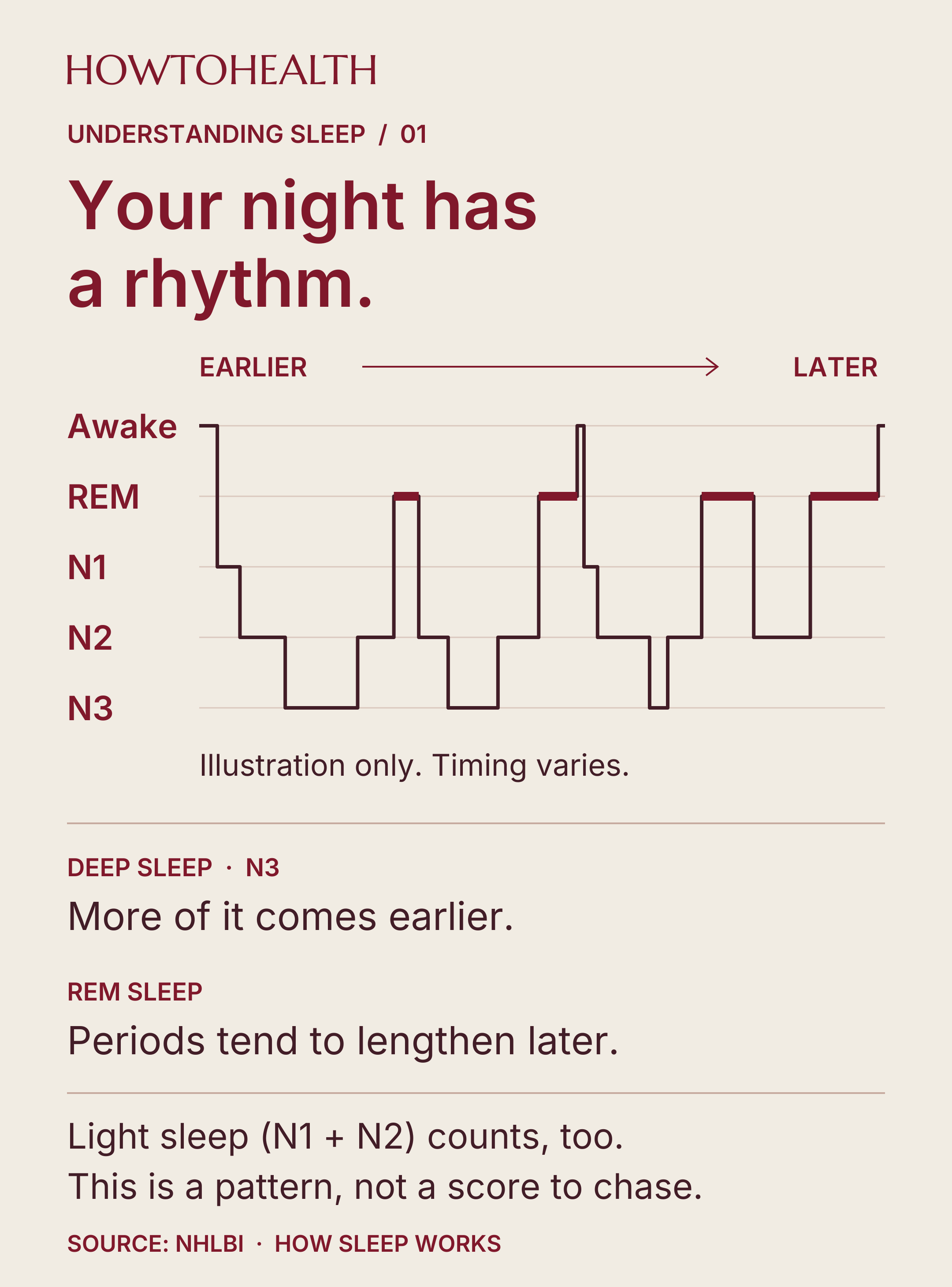
An early cycle often moves from N1 through N2 and N3, back toward lighter sleep, and into REM. Later cycles hold less deep sleep and longer REM periods. Understanding sleep
You’ll hear “90-minute cycles.” Treat it as a rhythm rather than a train timetable. Cycle lengths vary, and every cycle doesn’t contain the same amount of every stage, so setting an alarm in neat 90-minute multiples can’t reliably arrange a perfect wake-up. Sleep physiology
Here is why the order matters: the morning part of your sleep still has work to do. Routinely cutting it short removes sleep from the part of the night that’s usually richest in REM. Getting some deep sleep early doesn’t make the remaining hours optional.
Waking briefly is part of a normal night, and you may remember none of it. The concern is persistent difficulty getting back to sleep, distress, or a day that suffers for it, not the fact that you noticed the room once. Nighttime awakenings
Screenshot this: your night, at a glance
N1: drifting off. A few minutes. Where the falling jolt lives.
N2: light sleep that counts. About half the night.
N3: deep, slow-wave sleep. Mostly early in the night. Hardest to wake from, and the stage that shrinks most with age.
REM: active brain, still body, vivid dreams. Longer periods toward morning, so an early alarm cuts into them.
The whole night: four to six cycles of roughly 90 minutes, with proportions that shift as the night goes on.
Before you inspect your sleep score
A watch or ring estimates sleep stages from indirect signals. In a study comparing six wrist-worn devices with a laboratory sleep study in 62 adults, mostly men, agreement with the lab ranged from fair to moderate; the devices were good at telling asleep from awake and rougher on the stages. Use trends as a conversation starter. One low “deep sleep” number can’t tell you that your brain missed its repair shift. Wearable validation study
2. Why can you be exhausted and wide awake?
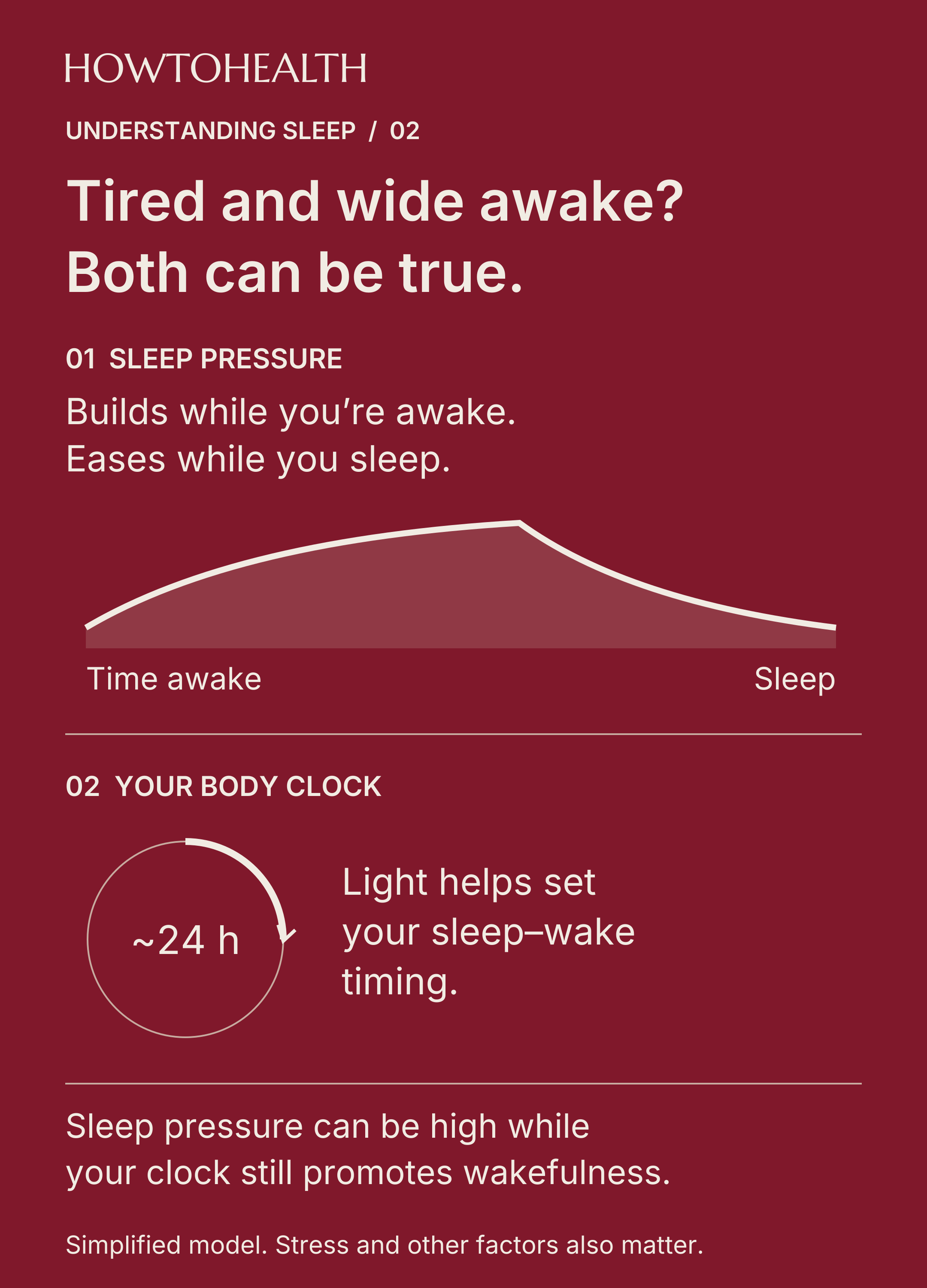
Well-established: two interacting systems decide when you sleep. The two-process model
Sleep pressure is the need for sleep that builds while you’re awake and eases while you sleep. Adenosine, a chemical involved in that process, is part of the reason you get sleepier after a long day. A nap relieves some of the pressure. Caffeine blocks adenosine’s action, which makes you feel more awake without replacing the sleep you need. Your sleep-wake cycle, Caffeine pharmacology
Your circadian rhythm is your roughly 24-hour internal schedule. It times alertness, sleepiness, temperature, and hormone release. Light reaching your eyes is the main signal that keeps this clock lined up with the outside day. Your sleep-wake cycle
Your clock also produces a strong alerting signal in the hours before your usual sleep period. The evening “second wind” is real, even after a tiring day. The two-process model
Usually the two systems cooperate: you’ve been awake long enough to need sleep, and your clock is moving into its biological night. But you can carry plenty of sleep pressure while your clock is still cheering for wakefulness, and stress can add a layer of alertness on top. “I’m exhausted” and “I can fall asleep now” are different experiences.
Three familiar things live inside this timing system:
Melatonin helps signal biological night. Evening light can delay or suppress its rise. It’s one signal in a much larger system, which is why swallowing more of it doesn’t solve every sleep problem. Room light and melatonin
Core temperature falls as the body prepares for sleep. Comfortable cooling matters; you don’t need a cold-plunge bedroom. Understanding sleep
Cortisol follows a daily rhythm too, generally lowest early in the biological night and rising toward morning. That rise is normal. A 3 a.m. awakening, by itself, can’t tell you whether your cortisol is abnormal. Cortisol rhythms
Once you understand the pressure and the clock, the usual advice stops sounding random. A long late nap can make bedtime harder because it drained the pressure. A brightly lit evening can tell the clock that night is arriving later. Neither means you’re bad at sleeping.
3. What are you getting from all those hours?
You know what a bad night feels like. Everything takes a little more effort. The email feels ruder. Remembering why you walked into the room becomes a group project.
Sleep supports attention, learning, emotional steadiness, metabolism, and immunity. None of this means every tired day is quietly ruining you. What the research does show is that you’re a poor judge of how little sleep you can get away with.
Well-established: in a controlled experiment, people allowed four or six hours in bed each night for two weeks developed accumulating problems with attention and other cognitive tasks. The impairment reached levels seen after one to two nights without sleep, depending on the restriction and the task. Their ratings of sleepiness barely moved after the first few days. “I’m used to it” was an unreliable measure of how they were doing. Chronic sleep restriction experiment
I heard “I’m fine on five hours” in clinic more than I heard almost anything else, usually from the women carrying the most: the job, the household, a baby, a parent, sometimes all of it at once. Some of them had no choice that month, and I’m not going to pretend a bedtime routine fixes a life that doesn’t leave room for one. What I’d want you to know is that the five hours aren’t free. Surviving on less sleep doesn’t make you stronger; it’s a bill, and you’re the one who pays it later. If the hours truly aren’t there right now, that’s a reason to protect every one you can get and to ask for help with the load, not a reason to feel bad about yourself.
Your mood and your ability to handle the day
Current evidence suggests sleep loss makes positive emotions harder to reach and increases anxiety symptoms. That comes from a review of 154 experiments involving more than 5,000 participants. Effects on negative emotions varied with how sleep was disrupted and what was measured, and the studies weren’t exclusively in women. Sleep loss and emotion
That’s a reason to take sleep seriously when life feels harder to manage. It doesn’t make sleep the explanation for every mood symptom. Persistent anxiety, depression, or distress deserves attention in its own right, alongside sleep.
Blood sugar, appetite, and energy
Insulin is the hormone that moves glucose from the blood into cells. Current evidence suggests repeatedly shortening sleep makes that job harder: in a trial of 38 women, about 80 minutes less sleep each night for six weeks increased insulin resistance. These women had risk factors for conditions such as diabetes or heart disease, without established disease, and the trial measured a metabolic change, not new cases of diabetes. Sleep restriction in women
You may also notice that appetite, or the appeal of certain foods, changes after poor sleep. The popular explanation is that sleep loss turns the hunger hormone up and the fullness hormone down; the famous version of that finding came from a study of 12 men. Hunger hormones after short sleep Human results since then, especially on sex differences, are less tidy. A recent review found inconsistent changes across appetite hormones and studies too small to settle many differences between women and men. Sex and appetite-hormone responses
Your immune system
Current evidence suggests sleep supports how the body responds to infection and vaccination. In the often-cited cold study, 164 adults were exposed to a cold virus; those sleeping six hours or less beforehand had about four times the odds of developing a cold compared with those sleeping more than seven. That was a deliberately controlled exposure, not a promise that good sleepers never get sick. Sleep and cold susceptibility
A later meta-analysis linked objectively measured short sleep with a weaker antibody response to vaccination. The women-only estimate was uncertain, so nobody should pretend we know the exact effect in women. Sleep and vaccine responses
Does sleep “wash your brain”?
You’ll see this claim everywhere, usually next to something for sale. Here’s what’s behind it.
Current evidence suggests the brain does something during sleep that it doesn’t do awake. In humans, slow waves of the fluid surrounding the brain have been measured pulsing through it during sleep, and in a small study of 24 adults, one night without sleep slowed the clearance of an injected tracer from the brain. Human fluid waves, Human clearance study
Uncertain or contested: whether that flow actually clears waste, how much, and what it means for preventing disease. The animal studies that started the story now conflict with each other, and the methods are debated. Nobody has shown that a bad night causes lasting damage, or that any product or “deep sleep” habit protects you from Alzheimer’s disease. Conflicting experimental findings
What to take from it: sleep is doing something for your brain that you can’t get another way, which is a reason to protect it. It’s not a reason to buy anything, and not a reason to lie awake worrying about lying awake.
So how much do women need?
For most adults, seven to nine hours is the useful starting range, with individual and age-related variation. The American Academy of Sleep Medicine and the Sleep Research Society put the floor for adults at seven or more hours a night. AASM/SRS consensus on sleep duration A 2026 review did not find grounds for a separate women-only number. Sleep-duration evidence review
Think about three things: whether you have an adequate chance to sleep, how you function during the day, and whether sleep feels restorative. A naturally short sleeper is a different person from someone who’s fighting sleep every day. You don’t need to diagnose your genes to take persistent tiredness seriously.
4. Why does your sleep change across your life?
Here’s the part the sleep research world has been slow to admit. A 2014 expert report from the Society for Women’s Health Research listed the open questions: how common sleep problems really are in women, how women’s sleep is regulated, how to measure its quality, how to diagnose it, and how to treat it. Sex and gender differences in sleep, expert report That was 2014. Reviews published in 2024 and 2026 still describe women as underrepresented in sleep and circadian research, still find sleep apnea being diagnosed with criteria built around male physiology, and still list women’s sleep disorders as underdiagnosed, with symptoms that don’t match the textbook and screening tools that work less well in women. The one clear improvement: most sleep studies now at least report whether they enrolled women, men, or both. Who gets studied in sleep research, 2024, Sex differences review, 2024, Sleep apnea in women, 2026 review, Women’s sleep research directions, 2026
So where I can tell you something solid about women specifically, I will. Where the answer is “nobody has studied that in women yet,” I’ll say that too.
What we do know: women have a higher risk of insomnia than men, about 40% higher in a large meta-analysis. A laboratory study found a slightly shorter internal circadian period in women, by about six minutes on average. Useful biology, and nothing you need to do anything about. Insomnia by sex, Internal clock study
Current evidence suggests women without insomnia show more sleep spindles and stronger slow-wave activity on recordings, on average, than men without insomnia. Yet women are more likely to report insomnia. A favorable-looking brain-wave feature isn’t the same as a restful lived experience. If your sleep looks fine on paper and feels terrible in life, the paper is not the final word. 2026 sleep-activity review
What matters most in your own life is the pattern: what changed, what came with it, and what’s getting between you and sleep. Here’s how that tends to go.
Young adulthood: when your free time starts at bedtime
If you’re reading this at 11:40 p.m. on your phone, hi.
You finally stop being useful to everyone else. You sit down. Someone sends a video. Suddenly tomorrow has started.
Researchers call some of this bedtime procrastination: delaying bed despite intending to sleep, with nothing external requiring you to stay awake. Across studies it’s associated with shorter and poorer sleep. Those studies can’t prove a phone causes every late night; stress, a later body clock, or a shortage of personal time is often part of the story. Bedtime procrastination review
The thing to watch is the moment bedtime disappears. A stopping cue, autoplay off, or the phone charging across the room can help if you keep going after you meant to stop. If nighttime is your only personal time, protecting some earlier time matters too, and that may take help or a change in who does what, not more willpower.
If you have the opportunity, put the phone down, and still can’t sleep, that deserves a different conversation. It’s in section 6.
The menstrual years: notice your pattern without expecting one
Two different cycles share a word here. A sleep cycle is the sequence repeated within a night; a menstrual cycle runs from one period to the next. Hormonal shifts across the menstrual cycle can influence sleep, but the two aren’t interchangeable.
Current evidence suggests the cycle affects temperature more consistently than it affects everyone’s sleep. After ovulation, progesterone rises and core temperature typically runs higher. Some women notice worse sleep before a period, particularly with pain, PMS, or PMDD, a condition involving severe premenstrual mood symptoms. Cycle-related sleep review
In a study of 116 women, temperature changed across the cycle, but measured sleep duration and quality did not show significant phase-related changes. There’s no universal “bad sleep week” to brace for. Menstrual-cycle study
Clinical observation: I always asked women whether the sleep problem showed up at a particular point in their cycle. “This happens before my period, and the pain wakes me” tells us far more than “my hormones are off.” A simple note on your calendar can show you a pattern; you don’t need to track every temperature fluctuation.
Mechanistic plausibility: progesterone’s metabolites act on brain pathways involved in calming and sleep. Trials of prescribed progesterone in selected women are a separate question from what your natural cycle will do. The mechanism can’t tell us that everyone sleeps best after ovulation, or that a bad night means progesterone is low. Progesterone and sleep trials
Pregnancy: common doesn’t mean you have to put up with everything
Sleep changes for very ordinary physical reasons: nausea, reflux, needing to urinate, discomfort, and the search for a position that works. Sleep disorders also occur during pregnancy, including restless legs, insomnia, and obstructive sleep apnea, and sleep complaints affect more than half of pregnancies. Sleep disorders in pregnancy
The useful next step is to name what’s waking you. Reflux, painful legs, and breathing interruptions need different help. Restless legs is common in pregnancy, the risk rises with the number of pregnancies a woman has had, and iron studies are part of that evaluation. New loud snoring, gasping, or witnessed breathing pauses belong in prenatal care, not waved away as one more pregnancy symptom; current pregnancy-specific guidance supports screening, assessment, and treatment for sleep apnea. Restless legs guideline, 2026 pregnancy apnea guideline
Current evidence suggests pregnancy-adapted cognitive behavioral therapy for insomnia, CBT-I, improves insomnia. In a trial of 194 pregnant women, it cut insomnia severity by more than a comparison therapy and brought remission faster. That gives you an option beyond “wait until the baby arrives,” which is a strange thing to say to a tired pregnant woman. Randomized pregnancy trial
Postpartum: being woken and being unable to sleep can coexist
A baby who needs you repeatedly is reducing your opportunity to sleep. No amount of perfect sleep hygiene creates uninterrupted hours that aren’t available.
For that problem, practical support matters: another person taking a feasible share of care, a protected rest window, work taken off your plate. What’s possible depends on feeding, recovery, household support, and the baby. Start from what’s actually available to you. A small change you can keep beats a perfect plan you can’t use.
There can also be insomnia on top of the interruptions: the baby is asleep, someone else is on duty, and you’re wide awake anyway. Current evidence suggests adapted CBT-I helps. In a trial of 114 women four to twelve months postpartum, CBT improved insomnia and fatigue. The study excluded women with very frequent infant-related waking, so it doesn’t solve the problem of being needed all night. Postpartum trial
Sleep trouble that comes with significant anxiety or low mood deserves a postpartum mental-health conversation as well. “Sleep when the baby sleeps” leaves a lot of women out.
Perimenopause and menopause: the old bedtime may stop working
You haven’t changed the room. You haven’t changed the coffee. Suddenly you’re throwing the covers off and mentally attending a meeting at 4 a.m.
Sleep complaints climb through this transition. A 2026 meta-analysis that pooled 102 studies of mood, anxiety, and sleep symptoms in midlife women put insomnia symptoms at about 27% of women in perimenopause and 42% after menopause. Insomnia across the menopause transition
Current evidence suggests hormonal changes and hot flashes contribute, and neither explains every sleep problem in the transition. In a sleep-lab study of 34 perimenopausal women, about 69% of measured hot flashes came with an awakening, and hot-flash waking added up to about 17 minutes a night, roughly a quarter of all time awake. Pain, mood, stress, bladder symptoms, insomnia, and sleep apnea all matter too. Hot flashes and awakenings, Menopause sleep review
If heat or sweating wakes you, treating those symptoms may improve sleep. Hormone therapy is one option for appropriate candidates with bothersome menopausal symptoms; the choice depends on the whole health picture. If you’re awake even when you’re comfortable, insomnia may need its own treatment. Both conversations can happen at the same visit. Hormone therapy and sleep
CBT-I has evidence in midlife women, including trials specifically in women with menopausal symptoms. A recent pilot in 43 perimenopausal and postmenopausal women found greater improvement in insomnia with CBT-I than with menopause education. Midlife CBT-I trial
Later adulthood: lighter sleep is not the same as needing almost none
Sleep often becomes lighter and shifts earlier with age; the deep sleep from section 1 is the part that shrinks most. Pain, nighttime urination, medications, and sleep disorders add disruption. “I’m older now” is a reason to understand the change, not to dismiss persistent exhaustion. Sleep and older adults
A review of what wakes you, your medication timing, and daytime sleepiness is usually more useful than another sleep product. If your schedule has drifted earlier and you feel well, that’s a different situation from being awake early and miserable.
And the phase no hormone chart includes: shifts and caregiving
A rotating schedule, night work, or caring for another person can make ordinary sleep advice impractical. Night work asks you to stay awake during biological night and sleep when your clock is promoting wakefulness. Sleep timing and shift work
The realistic priorities are a protected sleep opportunity, a bedroom that can be dark and quiet during your sleep hours, help where it exists, and a plan for unsafe sleepiness. Timed light and melatonin depend on the actual schedule; generic “morning light” advice can point a night worker in exactly the wrong direction.
If you’re struggling to stay awake while driving, stop and arrange a safe alternative. That’s a today problem; it can’t wait for a sleep plan to work.
5. Four rules you’ll hear about women’s sleep, graded
Women’s fitness and wellness content is full of confident rules about how women’s sleep is different. Some of it is good science, some of it is one small study, and some of it is a guess repeated often enough to sound settled. I’m including the four I hear most, because women are rearranging their evenings, their workouts, and sometimes how they feel about needing sleep at all, on the strength of rules that deserve a closer look.
“Women are more sensitive to evening light.”
How firm: Current evidence suggests, partly.
What the evidence says: in a dose-response study of 56 young adults, women’s melatonin was suppressed more than men’s by bright light, 400 lux and up, but not by the dim-to-moderate light of an ordinary evening at home. Light sensitivity by sex
What to do: dim the room in the last hour and keep the brightest screens out of your face. You don’t need special glasses on the strength of this claim.
“Women enter REM sooner.”
How firm: Current evidence suggests the opposite.
What the evidence says: on brain recordings, women take longer to reach REM, both in a meta-analysis of sleep-lab data from 5,273 healthy adults and in a sleep-clinic sample of 2,365 patients. The one study that found the reverse measured 19 teenage endurance athletes with a bedside radar over 61 nights, not brain recordings. Normal sleep-lab values, Sleep-lab sex differences, Junior athlete study
What to do: nothing. Anyone selling you a women-specific REM timing plan is working from the weaker study.
“Women need about twenty minutes more sleep.”
How firm: Uncertain or contested.
What the evidence says: women do sleep a little longer in large datasets and report wanting more; whether that’s biology or whose alarm sets the weekday is an open question, and no guideline sets a different number. Sleep need by sex across the lifespan
What to do: don’t hold yourself to a number from either direction. If you consistently need more sleep than the people around you and feel better when you get it, that’s information worth trusting.
“Late workouts hurt women’s sleep more.”
How firm: Current evidence suggests evening exercise is fine for most people, and no trial has compared the sexes.
What the evidence says: evening exercise is generally compatible with good sleep; a hard session ending within an hour or two of bed is where the cost shows. Evening exercise meta-analysis
What to do: if you train in the evening and sleep well, keep it. If you don’t, finish the hard session earlier, or make the late one easy.
The point of this list isn’t that the claims are wrong. Know how firm each one is before you build a routine around it. The same test applies to every rule you’ll hear about women and sleep, including mine.
6. Which kind of bad night are you having?
Clinical observation: when a woman told me she wasn’t sleeping, my first job was to figure out which problem she had, because they need different help. I asked whether she actually had enough chance to sleep. I asked about snoring and breathing pauses, and about legs that wouldn’t stay still in the evening, because sleep apnea and restless legs get missed in women constantly. I checked ferritin early, especially in women with restless legs or who were waking at night; the restless legs guideline backs that check, and for insomnia without leg symptoms it was my practice rather than a guideline. I asked where she was in the menopause transition. And when the stress piece didn’t add up, looking at where her cortisol rhythm sat against her day helped me understand her nights. That was a lens I found useful, not a test anyone needs before getting help, and it’s a question about rhythm rather than a worn-out gland (more on that below). Sleep habits came up too. They were rarely the whole story.
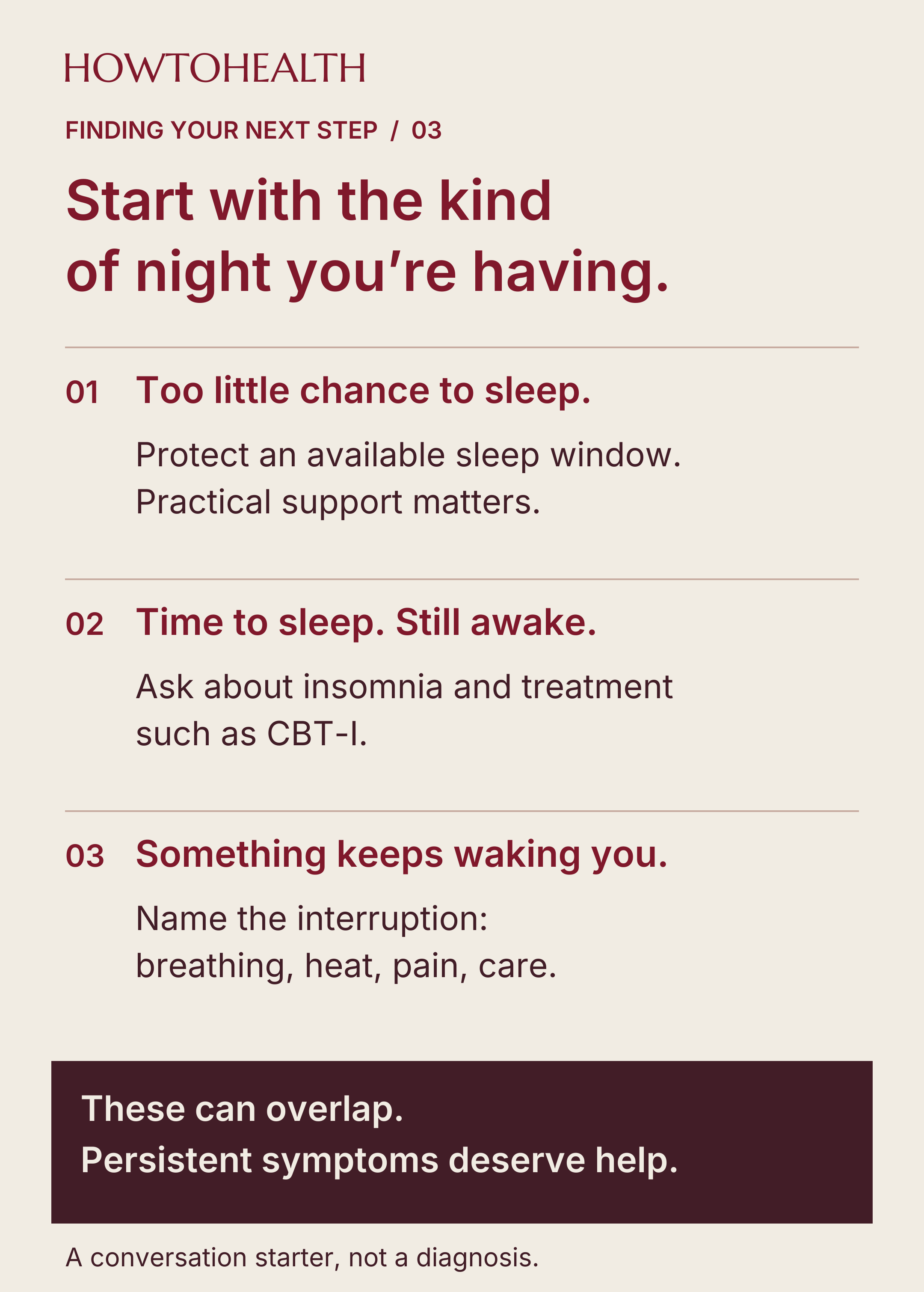
So before buying anything, ask three questions: Did I have enough chance to sleep? Was I unable to sleep despite that chance? Or was something repeatedly interrupting me? You can answer yes to more than one.
“I cannot switch off.”
You’re sleepy on the couch. In bed, you start calculating tomorrow, reviewing yesterday, and checking whether sleep has arrived yet.
Current evidence suggests heightened alertness, often called hyperarousal, is one important part of insomnia. The bed can also become associated with frustration and trying to sleep. None of that means you’re causing the problem by thinking incorrectly. It means learned patterns and the body’s alerting systems can keep a problem going after the original trigger has passed. Hyperarousal and insomnia
That’s one reason “try harder to relax” is such unhelpful advice. Sleep is difficult to force. The treatment built for this exact pattern is CBT-I, further down in this section.
One check worth making if the trouble switching off is new and comes with a racing heart, feeling hot when nobody else is, unexplained weight loss, or shaky hands: an overactive thyroid can look like anxiety and sleeplessness, and it’s a blood test. Hyperthyroidism symptoms, NIDDK
“I fall asleep, then I’m back at 3 a.m.”
First, give the time less power. Three o’clock doesn’t identify one hormone, organ, or diagnosis. The useful detail is what happens around the waking:
Hot, sweaty, or throwing off the covers? Menopausal symptoms may be part of it.
Snoring, gasping, or being told you stop breathing? Bring up sleep apnea.
An urge to move your legs, worse at rest in the evening and relieved by movement? That’s the pattern of restless legs syndrome. The guideline recommends checking iron studies, including ferritin, a measure of stored iron, before anyone reaches for an iron supplement.
Reflux, pain, congestion, or repeated bathroom trips? Those deserve attention alongside sleep.
A pattern after alcohol or later caffeine? A clue worth investigating, even though it doesn’t prove the cause.
Women’s sleep apnea, Restless legs guideline, Menopause sleep review
What can help in the moment? A brief awakening doesn’t need an intervention. If you’re comfortable and drifting, let that happen. If you’re increasingly alert and frustrated, a standard part of CBT-I is to take a quiet break from trying to sleep, keep the light low, and return to bed when sleepy. It rebuilds the connection between bed and sleep. You don’t need to watch the clock to earn permission to get up. Stimulus control evidence
Choose something undemanding, like a familiar book or calm audio. This is not the moment for your work inbox. Adapt the approach if getting out of bed is unsafe or difficult, including with mobility limitations or caregiving.
“I wake too early, and that’s it.”
Look at the whole day. Are you getting sleepy much earlier too? Has your schedule shifted? Is there new low mood or loss of interest? Early waking can come with insomnia, changes in body-clock timing, and depression. The pattern deserves attention without assuming one explanation. Sleep and aging, Depression symptoms
“I wake up from dreams I’d rather not have.”
Nightmares that keep coming, especially after something frightening happened to you, are a sleep problem with their own name and their own treatments. The one the American Academy of Sleep Medicine recommends first, for both trauma-related nightmares and nightmare disorder, is a structured therapy that rehearses a different ending to the dream while you’re awake. If bad dreams are what’s wrecking your nights, say so at the visit; “I can’t sleep” doesn’t tell anyone that part. AASM nightmare-disorder position paper
“I sleep fine, but only on a schedule the world won’t accept.”
If you reliably sleep well from very late at night until late morning, but can’t sleep on an earlier required schedule, timing may be the central problem. A later preference alone isn’t a disorder. A persistent mismatch that causes impairment can be a circadian sleep-wake disorder.
Treatment may involve carefully timed light and, in selected situations, melatonin. Current evidence suggests strategically timed melatonin helps delayed sleep-wake phase disorder. Timing matters because the aim is to shift the clock; taking a gummy whenever you finally get into bed is a different proposition. Circadian treatment guideline
“I sleep all night and still feel awful.”
Time in bed isn’t a complete measure of sleep. Obstructive sleep apnea repeatedly narrows or blocks the airway during sleep. Women may report fatigue, insomnia, headaches, or mood symptoms as well as the familiar snoring and breathing pauses, and it gets missed when the mental picture is always a loudly snoring man. In the community, apnea is about twice as common in men; in older data from sleep centers, men outnumbered women about eight to one, and the women who were diagnosed were heavier and treated later. Sex and gender differences in sleep, expert report, Sleep apnea in women
Persistent unrefreshing sleep deserves assessment, especially with breathing symptoms or pronounced daytime sleepiness. Mention congestion and mouth breathing too. Taping the mouth shut is not a substitute for finding out why breathing is difficult. Mouth-taping evidence review
Clinical observation: mouth breathing on its own doesn’t mean sleep apnea, but the women I saw who breathed through their mouths at night rarely woke refreshed. The useful question was always why: congestion, allergies, or an airway problem an ear-nose-throat clinician can assess. Tape covers the symptom and hides the question.
If you have PCOS, renamed PMOS, polyendocrine metabolic ovarian syndrome, in May 2026 (the new name will take a few years to catch on), sleep apnea deserves particular attention. The international guideline reports higher prevalence even after accounting for body size and recommends assessment when symptoms are present. That’s why sleep belongs in the hormone conversation too. The 2026 rename, in The Lancet, International guideline, The HowToHealth PCOS/PMOS series
Where does “adrenal fatigue” fit?
The fatigue is real. The proposed diagnosis of exhausted adrenal glands has not held up in research. Real adrenal diseases exist and need proper evaluation; feeling depleted doesn’t diagnose them. Adrenal fatigue systematic review
A cortisol rhythm that’s out of step with your day, the kind that comes with chronic stress, shift work, or sleep loss itself, is a different and real thing: a rhythm problem, not a worn-out gland. Cortisol rhythms
The next question is what explains the symptoms: insufficient sleep, insomnia, a breathing problem, medication effects, mood, or another health condition. A label is only worth having if it leads somewhere.
The treatment that deserves more airtime: CBT-I
Well-established: cognitive behavioral therapy for insomnia is a first-line treatment for chronic insomnia. Sleep hygiene by itself is not an adequate substitute. AASM behavioral treatment guideline
CBT-I is a structured treatment that works on sleep timing, the connection between bed and wakefulness, and the worry and behaviors that keep insomnia going. It may include adjusting time in bed under appropriate guidance. In 20 trials with 1,162 participants, 64% of them women, it cut the time to fall asleep by about 19 minutes and time awake during the night by about 26 minutes, with gains that held after treatment ended. CBT-I research
Chronic insomnia generally means persistent difficulty falling asleep, staying asleep, or waking too early, at least three nights a week for at least three months, despite adequate opportunity, with daytime consequences. That definition is not an instruction to wait three months before asking for help. Insomnia classification
How to actually get it. This is where most articles stop, so here’s the practical part.
Digital CBT-I works. In a 2020 meta-analysis of 33 randomized trials with more than 9,000 participants, app- and web-delivered CBT-I cut insomnia severity by about five points on the standard 28-point scale, with gains still present a year later. Face-to-face treatment did a little better, by about three points, which the authors judged close enough to call the digital versions non-inferior. An earlier review found effects comparable to in-person CBT-I. Digital CBT-I meta-analysis, 2020, Internet CBT-I meta-analysis, 2016
There are public versions you can start tonight. The U.S. Department of Veterans Affairs built two, and you don’t have to be a veteran to download them from the app stores. Insomnia Coach is a self-guided weekly program with a built-in sleep diary; it’s the one to start with on your own. CBT-i Coach is designed as a companion to treatment with a clinician, not as a standalone program. Insomnia Coach, VA, CBT-i Coach, VA
There are clinicians who do only this. Behavioral sleep medicine specialists keep a public directory, browsable by region, with a separate list of those who see patients by telehealth. Society of Behavioral Sleep Medicine directory, SBSM telemedicine list
Ask for it by name. A generic meditation app is not CBT-I. The sentence to bring to a visit: “Can we assess what’s disrupting my sleep, and is CBT-I appropriate for me?”
Where does medication fit?
Sleep medication exists for a reason, and needing it is not a personal failure. The American Academy of Sleep Medicine’s 2026 guideline on combining treatments puts CBT-I alone ahead of CBT-I plus medication, and CBT-I plus medication ahead of medication alone. Both recommendations are conditional, on low-certainty evidence, and the guideline notes that someone who values more sleep quickly may reasonably choose the combination. Access, preferences, symptoms, and other conditions all matter. 2026 AASM combined-treatment guideline
So you can follow the conversation, here are the names a prescriber might raise. The AASM’s medication guideline suggests, on weak evidence, a handful of options for chronic insomnia: the newer orexin blocker suvorexant, for staying asleep; the sedative-hypnotics zolpidem, eszopiclone, and zaleplon, mostly for falling asleep; low-dose doxepin, an old antidepressant, for staying asleep; ramelteon, which works on melatonin receptors; and two benzodiazepines, temazepam and triazolam. The same guideline suggests against trazodone, diphenhydramine, melatonin, tryptophan, and valerian for chronic insomnia, because the evidence doesn’t support them for that job. Which fits, if any, depends on whether your problem is falling asleep, staying asleep, or both, and on everything else you take. None of this is dosing advice; it’s so the names aren’t a surprise. If you’re already on one and it’s working, that’s a conversation with your prescriber, and nothing in this article should talk you out of it. Insomnia medication guideline
7. What are coffee, wine, and the sleep aisle doing?
Clinical observation: I asked every woman what she was using to try to sleep, including alcohol, cannabis, and melatonin, and what she was using for energy, including energy drinks like Celsius and supplements. Some were buying energy supplements without realizing those could be the reason they couldn’t sleep later. I tried to get women to stop all of it for at least two weeks, to see what changed once it was gone.
Bring the actual names and labels to the conversation. “Just a gummy” tells us very little about what’s in it. And if you want to run your own version of that two-week experiment, two cautions: prescribed medicines stay, and regular heavy drinking is not something to stop abruptly on your own (more on that under alcohol).
Caffeine: the feeling wears off before the caffeine does
Well-established: caffeine blocks adenosine’s action. How quickly you clear it varies, and so does how strongly it affects your sleep. Caffeine pharmacology
The useful word is half-life: the time it takes for the amount in your body to fall by half. Using a five-hour half-life as an illustration, half the caffeine from a 2 p.m. coffee is still around at 7 p.m., and a quarter at midnight.
That’s why “I can fall asleep after coffee” doesn’t settle whether coffee affects the night. Across 24 studies, most of them in men, caffeine reduced total sleep by about 45 minutes on average. The amount and timing differed between studies, so that’s not a prediction for your next cup. Caffeine and sleep meta-analysis
For women, context matters. Estrogen-containing oral contraceptives slow caffeine clearance. In a small, older study, the average half-life was about 7.9 hours in pill users versus 5.4 hours in controls. Clearance also slows during pregnancy. Caffeine and oral contraceptives
Small studies of caffeine across the menstrual cycle have reached different conclusions. In two studies of 10 women each, one found slower clearance before a period; the other found no significant difference across phases. That doesn’t justify assigning every cycling woman a different caffeine cutoff for each phase. Caffeine metabolism review, Cycle study, 1992, Cycle study, 1999
The practical questions are how much, how late, and what else contains it. Look beyond coffee to tea, matcha, energy drinks, pre-workout, and products with guarana or yerba mate. “Natural” caffeine does caffeine’s job, and labels can be imperfect. Caffeine supplement analysis
If sleep is a problem, earlier or less caffeine is a reasonable variable to test. There’s no universal hour at which everyone’s last cup becomes harmless, and decaf still contains small amounts. Decaf analysis
A quick caffeine comparison
These are typical amounts in the same 12-ounce serving, from the FDA’s own table, not recommended intakes. Brands and preparation vary.
Drink (12 oz) · Approximate caffeine
Brewed coffee: 113–247 mg
Black tea: 71 mg
Green tea: 37 mg
Caffeinated soft drink: 23–83 mg
Energy drink: 41–246 mg
Check the amount in the whole container you actually drink, because “one drink” can mean very different things: a 12-ounce can of Celsius lists 200 mg, about two cups of coffee, and by the half-life math above a 2 p.m. can is still half there at 7 p.m. The FDA’s general ceiling for healthy adults is about 400 mg a day. FDA caffeine reference
Alcohol: getting sleepy is only the beginning of the night
Well-established: alcohol changes sleep architecture, including delaying and reducing REM. A review of 27 studies, which didn’t separate women from men, found more REM disruption with more alcohol, beginning around two standard drinks; faster sleep onset showed up at higher amounts, not reliably at lower ones. Alcohol and sleep meta-analysis
So “it helps me fall asleep” can be true while the overall night is worse. In one controlled study at similar bedtime alcohol levels, women’s sleep continuity was more disrupted than men’s. Alcohol and sleep by sex
A glass of wine you enjoy is your call. As an insomnia treatment it’s a bad trade: drowsiness now, a more broken night later. If you wake at 3 a.m. on wine nights and not on dry nights, write that down.
If regular heavy drinking or withdrawal symptoms are part of the picture, stopping abruptly without medical help can be dangerous. Alcohol-withdrawal guideline
THC, CBD, and CBN: three names, different evidence
THC is the main intoxicating cannabis compound, and the one in most sleep gummies. Is it helping or hurting? That depends on whether you mean tonight or every night.
Tonight: it can feel like it works. In one two-week trial of 23 people, 20 of them women, an oral THC-containing oil added about 33 minutes of sleep measured by a wrist device. Cannabinoid insomnia trial In the sleep lab the picture is less flattering: a single oral dose of 10 mg THC with 200 mg CBD, in 20 people with insomnia, 16 of them women, cut REM sleep by about 34 minutes and total sleep by about 25 minutes. A 2025 meta-analysis of sleep-lab studies found THC’s effects on sleep stages inconsistent, with REM suppression clearest at higher doses, and noted that people’s sense that they slept better often doesn’t match the recording. Current evidence suggests that much. Oral cannabinoid lab trial, Cannabis and sleep architecture meta-analysis
Every night: the evidence tilts the wrong way. In 177 adults, cannabis within three hours of bed was associated with more time awake after falling asleep and more light sleep, with no measure of better sleep. In 1,449 sleep-clinic patients, most with sleep apnea, daily use for a year or more was associated with more waking and lower sleep efficiency. None of these can prove cause. None of them points toward sleeping better, either. Cannabis near bedtime, Chronic use in a sleep clinic
When you stop: regular users often get a stretch of disrupted sleep and vivid dreams, which is REM catching up. Feeling worse the week you stop is not evidence that the gummies were fixing the underlying problem. A randomized study of access to medical cannabis also found better self-reported insomnia alongside a higher risk of cannabis use disorder. Sleep during abstinence, Medical-cannabis trial
Short trials can’t settle the lasting benefits or harms. What they do show: THC products change the shape of your sleep, dependable long-term benefit hasn’t been established, regular use carries a dependence risk, and stopping can bring a real stretch of worse sleep. If you use it, those are the tradeoffs.
CBD isn’t intoxicating in the same way, but that doesn’t make it an established sleep treatment. A 2024 trial of 30 people found no advantage over placebo for insomnia severity and most sleep outcomes, although one objective sleep measure improved. CBD insomnia trial
CBD can interact with medicines. In a 2025 trial in healthy adults, liver-enzyme elevations occurred in 5.6% receiving the studied CBD regimen and none receiving placebo. That’s a result for that regimen, not a risk estimate for every CBD product; it does establish that being sold over the counter isn’t proof of harmlessness. CBD liver-safety trial, Drug interactions
CBN, another cannabinoid marketed for sleep, sits under Uncertain or contested. An industry-run seven-night trial missed its main sleep-quality outcome, although some secondary outcomes, including awakenings, improved. A limited signal; nobody should be calling it an insomnia treatment yet. CBN trial
Melatonin: what problem are you asking it to solve?
Remember the clock: melatonin is part of the body’s night signal, which makes it useful for certain timing problems and a poor universal answer to a restless night.
Current evidence suggests its average benefit for some sleep problems is modest. A meta-analysis of 19 trials in adults and children found sleep onset about seven minutes earlier and total sleep about eight minutes longer. Those averages don’t apply equally to every diagnosis or age. Melatonin meta-analysis
The AASM suggests against melatonin for chronic insomnia in adults, while a separate guideline supports strategically timed use for selected circadian problems. That’s why “does melatonin work?” needs a second question: for what? Insomnia medication guideline, Circadian guideline
Product quality matters too. An analysis of 31 supplements found contents ranging from 83% below to 478% above the labeled amount. That study doesn’t describe every product today, but it shows why the label isn’t a precise measurement. Supplement-content analysis
Uncertain or contested: broad claims about years of nightly use. A six-month trial of a specific prolonged-release product offers some reassurance for that setting; it can’t establish the safety of every formulation used indefinitely. A longer-term plan deserves an actual reason and a review of whether it’s helping. Six-month trial
You may have seen a headline linking long-term melatonin to heart failure. It came from a conference abstract presented in late 2025 that, as of this writing, still hasn’t been published as a peer-reviewed paper, drawn from a records database where over-the-counter melatonin users are hard to count. A 2026 analysis of a national health survey found no association between recent melatonin use and heart failure, although that was a snapshot, not a study that followed people over time. It’s unresolved, which argues for using melatonin on purpose rather than by habit, without panicking about the bottle you already own. Melatonin and cardiovascular risk
The herbs: chamomile, valerian, lavender, ashwagandha, and the rest of the shelf
If you’ve seen an integrative clinician, a naturopath, or me, you’ve probably been handed at least one of these. I believe in some of them, I used them, and I still want to be straight with you about what they can do. Here’s the tension: some practitioners reach for an herb because they want a woman to walk out with something in her hand, and an herb is easier to hand over than a hard conversation about insomnia. I understand the instinct. It’s still not a treatment for insomnia. Used correctly, the better-studied ones can take the edge off a rough stretch of nights, and “natural” tells you nothing about whether one works or interacts with your medication. Here’s where each stands.
Chamomile. The best-studied of the teas. A 2024 meta-analysis of ten trials, 772 people, found better sleep-quality scores and fewer awakenings, but no change in how long people slept, their sleep efficiency, or how they functioned the next day. The one trial in diagnosed chronic insomnia, 34 people, found no difference from placebo on any sleep-diary measure. Current evidence suggests it improves the experience of sleep more than the measurement of it, which is still worth something at bedtime. Two cautions: allergic reactions, including severe ones, in people allergic to ragweed and its relatives, and reported interactions with warfarin and some liver-metabolized drugs. Chamomile meta-analysis, Chamomile insomnia pilot, Chamomile safety, NCCIH
Lavender. Two different things share the name. Smelling it has many small positive trials, mostly in older adults and hospital patients; a 2025 meta-analysis pooled ten of them in people over 60 and found better sleep scores, with a lot of variation between studies. Swallowing it, as a standardized oral lavender-oil capsule studied in Europe, improves sleep in people with anxiety, and the researchers’ own analysis found that more than 98% of the sleep benefit ran through the anxiety relief. So lavender is an anxiety tool that helps sleep when anxiety is what’s keeping you up. Current evidence suggests, for that situation. Lavender inhalation in older adults, Oral lavender and sleep
Passionflower. One decent trial: 110 adults with insomnia disorder, 54% women, two weeks, measured in a sleep lab. Total sleep time rose by about 23 minutes compared with placebo; the other measures improved but didn’t separate from placebo. Current evidence suggests, on a single trial. Passionflower sleep-lab trial
Valerian, with or without hops. The most-sold and the most disappointing. A 2024 umbrella review of eight systematic reviews concluded it has a good safety record and no demonstrated efficacy for insomnia: people rate their sleep a little better, and the measurements don’t move. The best single trial, a valerian-and-hops combination in 184 adults with mild insomnia, 110 of them women, found modest self-rated gains and nothing on the sleep recording. In the one meta-analysis that counted side effects, valerian had more of them per person than placebo, not fewer. Product quality varies widely, which is part of why trials disagree. Uncertain or contested. Valerian umbrella review, Valerian-hops trial, Herbal medicine for insomnia meta-analysis
Lemon balm. Almost always studied inside a blend, which makes it impossible to credit any single ingredient. A 2024 trial of a lemon balm, valerian, saffron, and L-theanine combination did no better than placebo on measured or rated sleep. Uncertain or contested. Combination trial
Ashwagandha. The one I’d be most careful with, and the one I most want you to understand. A 2021 meta-analysis of five trials, 400 people, found a small-to-moderate benefit on sleep, strongest in people with diagnosed insomnia and with longer use; the authors noted that long-term safety data are limited. The liver is the issue. A case series from Iceland and the US Drug-Induced Liver Injury Network described five people who developed jaundice and itching two to twelve weeks after starting ashwagandha-containing supplements; liver tests returned to normal in four of them over one to five months, and the fifth was lost to follow-up. A 2026 trial enrolled 1,002 adults, 498 on a standardized root extract and 504 on placebo for eight weeks, and found no significant liver-test differences between groups. That’s reassuring for the product and period studied; it can’t tell us how often rare liver injury occurs or establish long-term safety. Stop and get checked if you turn yellow, itch all over, or feel unwell on it. Current evidence suggests benefit; safety is Uncertain or contested. Ashwagandha meta-analysis, Ashwagandha liver-injury case series, Eight-week safety trial
Kava. Trial evidence for anxiety, not for insomnia, and a link to rare but sometimes fatal liver injury. It shouldn’t be combined with alcohol or sedatives. I wouldn’t use it for sleep. Herbal medicine for insomnia meta-analysis, Kava safety, NCCIH
Where that leaves you: chamomile, lavender when anxiety is the problem, and passionflower have a signal that’s worth something on a rough night. Valerian and lemon balm have a safety record and not much else. Ashwagandha has a signal and a liver question, so it’s the one I wouldn’t take casually or indefinitely. None of them does what CBT-I does for a sleep problem that has lasted months; most of the trials are small and short, and they measure how sleep felt more than how it went. Use them as what they are, a short-term nudge through a bad stretch. And if you’re pregnant or breastfeeding, on a blood thinner, an antidepressant, or anything your liver has to process, bring the bottle to the visit.
And magnesium, the PM pill, and everything else?
Uncertain or contested: magnesium as a routine insomnia treatment. The pooled evidence in older adults came from three small trials with low-quality evidence. Correcting a deficiency and treating insomnia are different questions. Magnesium evidence review
Clinical observation: many of my patients told me magnesium bisglycinate helped them settle at night. I take it myself, nightly, for more reasons than sleep, and I find the same. That is experience, theirs and mine, and I’m labeling it that way on purpose. For the record, I have a practitioner dispensary that carries it; nothing in this article links there, and you don’t need to buy anything to use this piece.
Over-the-counter sleep medicines belong in this conversation too. Diphenhydramine, the sedating antihistamine in most “PM” products, is not recommended by the AASM as a routine treatment for chronic insomnia. Bring the label, especially if a PM product has become part of every night. Insomnia medication guideline
A warm drink or a familiar evening ritual can be enjoyable without becoming a proven treatment. Before adding another product, ask what it’s supposed to change, whether human trials support that use, and whether it could interact with anything else you take.
8. The last hour: phones, TV, and the rest of it
There are at least three ways an evening screen can affect your night: the light, what you’re doing, and the time it takes. Changing one doesn’t automatically change the others.
A dim screen can still contain an argument, an alarming headline, or forty minutes of videos you didn’t mean to watch. And someone who already can’t sleep may reach for a phone, which matters when we read studies linking screen use with poor sleep: the relationship can run both ways.
Current evidence suggests evening screen use can interfere with sleep in some settings. A controlled study using prolonged evening e-reader exposure found delayed circadian timing and sleep changes compared with print. A much larger observational study, with mostly women participants, found an association between bedtime screen use and poorer sleep. The lab setup was more intensive than a quick text, and the observational study can’t establish cause. E-reader experiment, Adult screen-use study
Will a warmer or red screen fix it?
Mechanistic plausibility: the clock responds differently to different wavelengths of light, with particular sensitivity to the blue part of the spectrum, so reducing that exposure has a biological rationale. Brightness, duration, and the rest of the room’s lighting still matter. Human light-response study
Uncertain or contested: how reliably consumer filters or blue-blocking glasses improve sleep. In a randomized study of 167 young adults, 71% of them women, overall sleep outcomes didn’t differ significantly between Night Shift on, Night Shift off, and no phone at all. One detail is worth keeping: in an exploratory analysis done after the main comparison, participants averaging more than 6.8 hours a night slept better with no phone than with Night Shift on. A clue worth following; it wasn’t the trial’s main result. That trial didn’t test a full red filter. A Cochrane review found uncertain evidence for blue-light-filtering glasses and sleep. Night Shift trial, Cochrane review
What I do: my iPhone is set to turn the screen red in the evening so I can still read on it with less blue light. That’s a personal habit, and I’d never call it a treatment.
If you want a practical starting point, think about the whole evening: dimmer room lighting, comfortable screen brightness, less activating content, and a stopping point you can actually keep. A color setting can’t give back an hour spent scrolling.
“But I need the TV to fall asleep.”
The familiar voices may be comforting. Keep that part. The goal is to keep the comfort and lose the light and the program that keeps running after you’ve fallen asleep. Audio with the screen off, or a sleep timer, are reasonable things to try.
In a small laboratory study, sleeping in moderate room light increased overnight heart rate and reduced insulin sensitivity the next morning. That doesn’t tell us exactly what one TV does, but it’s a reason to make a darker room the default when you can. Light during sleep experiment
Sex, since nobody puts it on the sleep-hygiene list
If it’s already part of your evening, it counts. In a 14-day diary study of 159 adults, partnered sex with orgasm was tied to falling asleep faster and sleeping better; sex without orgasm was not. A small EEG pilot in seven couples found less waking during the night after sex, solo or partnered. Current evidence suggests, mostly from self-report, in people without insomnia. Take it as an observation. No trial has tested it in women who can’t sleep, and nobody is assigning you anything. Sex and sleep diary study, Couples sleep pilot
9. The cheat sheet: what’s worth trying first?
Choose the item that matches your problem. It’s a reference to come back to, and nobody is assigning you eleven things tonight. Habits can support sleep while medical problems are being assessed; you don’t have to finish this list before getting help.
Protect an actual chance to sleep. Count the available hours before optimizing the pillow. If work or care repeatedly takes those hours, the solution has to include the workload or the support. Most adults need substantially more than a five-hour window. Well-established. Sleep-duration review
Give your clock some consistency. A reasonably steady sleep-wake schedule is a useful aim where life allows. Large observational studies associate more regular sleep with better health, but they don’t prove an exact wake time prevents disease. Build consistency you can live with, not a new reason to dread Saturday. Current evidence suggests. Sleep regularity study
Make daytime look like day and the approach to bed look like night. For a typical daytime schedule, daylight after waking and less bright light before bed give the clock clear cues. Night shifts and persistent clock disorders need a schedule-specific approach. Well-established for light’s role in timing. Body-clock basics, Room light and melatonin
Look at the whole caffeine picture. Amount, timing, contraceptives, pregnancy, and individual sensitivity. Earlier or less tells you more than switching from one caffeinated product to another. Well-established that caffeine can disrupt sleep. Caffeine review
Let alcohol be an informed choice, not the sleep plan. Getting drowsy isn’t the same outcome as sleeping well across the night. Well-established. Alcohol review
Move in a way that fits your life. Evening exercise is generally compatible with good sleep. If a very hard late session repeatedly leaves you wired, play with timing or intensity. Nobody gets to take a woman’s only available workout away from her. Current evidence suggests. Evening exercise meta-analysis
Make the room comfortable and address what wakes you. Dark enough, quiet enough, and cool enough for you. A warm shower or bath before bed may help sleep onset, partly through the heat loss that follows. There’s no universal thermostat setting. Current evidence suggests. Warm-water evidence review
Let symptoms guide the food conversation. If lying down after eating brings reflux, meal timing may matter. That doesn’t justify a universal rule that women must eat a small dinner or go to bed hungry. Current evidence suggests that avoiding meals close to bedtime helps some people with reflux. Reflux guideline
Give winding down a realistic shape. A familiar book, music, a shower, or gentle stretching can mark the transition. You don’t need an elaborate ritual. For persistent insomnia, use the specific principles of CBT-I rather than adding more bedtime tasks. Well-established for CBT-I; no single perfect routine has been established. Insomnia treatment guideline
Use naps according to the problem. Naps improve alertness, but they also drain sleep pressure and can leave temporary grogginess. If falling asleep at night is hard, ask whether a long or late nap is contributing. A night worker or a sleep-deprived parent may need a different approach from someone with chronic insomnia. Current evidence suggests; no universal nap rule fits everyone. Napping review
Know when you need treatment. Persistent insomnia, repeated breathing symptoms, marked daytime sleepiness, restless legs, recurring nightmares, or sleep trouble with significant mood changes deserve assessment. Bring what you’ve noticed and what you take. Well-established for assessing sleep disorders and treating chronic insomnia. CBT-I guideline, Women’s apnea review
10. Daylight saving time and your sleep: what to do when the clocks change
Twice a year, most of the United States moves its clocks by an hour. Your phone changes instantly; your body clock takes longer, because it’s set by light and routine, not by a setting. Body-clock basics
When the clocks go back in November (this year: Sunday, November 1, 2026), you gain an hour. If the fall change tends to leave you sleepy in the evening and awake too early, sleep specialists suggest gently moving your schedule later in the days beforehand, keeping the room dark until your intended wake time, and getting regular daylight during the day. If you’re already short on sleep, the American Academy of Sleep Medicine’s advice is simpler: don’t shift anything, and take the hour as sleep. Parents, caregivers, and shift workers may not receive an extra hour at all. 2026 clock-change date, Sleep specialist’s fall-change guidance, AASM guidance on the clock change
When the clocks go forward in March, you lose an hour, and this is the harder change for most people: the days after the spring change are associated with more heart attacks, strokes, and car accidents, and both changes have been linked to mood disturbance. Sleep specialists’ standard advice is to shift bedtime a little earlier over the nights beforehand, get outside in morning light on the first days after, and keep the rest of your schedule steady. AASM guidance on the clock change
The American Academy of Sleep Medicine favors permanent standard time, because it lines up better with human circadian biology; its 2023 position statement is endorsed by twenty other organizations. The goal is less disruption for everyone, rather than getting very good at changing the clocks twice a year. AASM position statement, 2023 update
Leave with one next step
You don’t need to become a sleep researcher or a person with a six-step evening routine.
Try finishing this sentence:
“The thing getting between me and sleep is probably ____. My next step is ____.”
Maybe that means checking what’s in the afternoon energy drink. Maybe it means sharing a caregiving task. Maybe it means starting a CBT-I program tonight, or telling your clinician, “I have enough time to sleep, and I still can’t. I want help with that.”
More than once in this piece the answer was “nobody has studied that in women yet.” I’d rather tell you that than fill the gap with a guess.
And if you already sleep well, keep protecting it. You’re doing something worthwhile with those hours.
If someone sent you this, I hope it feels like being cared for. If a woman came to mind while you were reading, send it with that same intention.
What’s the part of your night you wish someone would explain?
Congratulations, we’re healthing.
Lindsay Savage, PA-C
Sources & evidence notes
Growth hormone and slow-wave sleep, JAMA, 2000 (149 healthy men, no women)
Wearable validation study, six devices versus polysomnography, 62 adults, 2025
The two-process model of sleep regulation, Journal of Sleep Research, 2016
Caffeine pharmacology and metabolism review, Pharmacological Reviews, 2018
Room light and melatonin, Journal of Clinical Endocrinology and Metabolism, 2011
Sleep loss and emotion, meta-analysis of 154 experiments, Psychological Bulletin, 2024
Sleep restriction and insulin sensitivity in 38 women, Diabetes Care, 2024
Hunger hormones after short sleep, Annals of Internal Medicine, 2004 (study in 12 men)
Sex differences in appetite-hormone responses to sleep loss, review, 2025
Sleep and vaccine antibody responses, meta-analysis, Current Biology, 2023
Sleep deprivation and tracer clearance in humans, Brain, 2021
Sex and gender differences in sleep health, Society for Women’s Health Research expert report, 2014
Reporting of sex and other demographics across 40 years of sleep and chronobiology research, 2024
Sex differences in sleep, circadian rhythms, and metabolism, review, Sleep Medicine Reviews, 2024
Sex inequities in sleep-disordered breathing, review, Sleep Medicine, 2026
Future research directions for women’s sleep health, Sleep Medicine Clinics, 2026
Sex difference in the intrinsic circadian period, PNAS, 2011
Sex differences in sleep EEG activity, review, Journal of Sleep Research, 2026
Bedtime procrastination, systematic review and meta-analysis, Sleep Medicine Reviews, 2022
Menstrual cycle and sleep, review, Current Opinion in Psychology, 2020
Temperature and sleep across the menstrual cycle in 116 women, Journal of Biological Rhythms, 2024
Progesterone and sleep, trials review, Journal of Clinical Endocrinology and Metabolism, 2021
Sleep disorders in pregnancy, Obstetrics and Gynecology, 2022
Restless legs syndrome clinical practice guideline, AASM, Journal of Clinical Sleep Medicine, 2025
CBT-I during pregnancy, randomized trial of 194 women, Obstetrics and Gynecology, 2019
CBT for postpartum insomnia and fatigue, randomized trial of 114 women, Psychological Medicine, 2022
Sleep in the menopause transition, review, Current Opinion in Obstetrics and Gynecology, 2025
CBT-I versus menopause education in 43 midlife women, pilot trial, Menopause, 2026
Sex differences in radar-measured sleep in junior endurance athletes, PLoS One, 2021
Sleep need by sex across the lifespan, Sleep and Breathing, 2025
Evening exercise and sleep, meta-analysis, Sports Medicine, 2019
Hyperarousal and insomnia, review, Sleep Medicine Reviews, 2010
Stimulus control for insomnia, evidence review, Journal of Sleep Research, 2023
International evidence-based guideline for the assessment and management of PCOS/PMOS, 2023
Adrenal fatigue does not exist, systematic review, BMC Endocrine Disorders, 2016
CBT-I for chronic insomnia, meta-analysis of 20 trials, Annals of Internal Medicine, 2015
Digital CBT-I, meta-analysis of 33 randomized trials, Sleep Medicine, 2020
Internet-delivered CBT-I, meta-analysis of 11 randomized trials, Sleep Medicine Reviews, 2016
Society of Behavioral Sleep Medicine, telemedicine providers
Caffeine and sleep, meta-analysis of 24 studies, Sleep Medicine Reviews, 2023
Caffeine clearance and oral contraceptives, European Journal of Clinical Pharmacology, 1985
Caffeine pharmacokinetics across the menstrual cycle, 10 women, 1992
Caffeine pharmacokinetics across the menstrual cycle, 10 women, 1999
Caffeine content of decaffeinated coffee, Journal of Analytical Toxicology, 2006
Alcohol and sleep architecture, meta-analysis of 27 studies, Sleep Medicine Reviews, 2024
Alcohol and sleep by sex, controlled study, Alcoholism: Clinical and Experimental Research, 2011
Alcohol withdrawal management, ASAM clinical practice guideline, 2020
Cannabinoid oil for chronic insomnia, two-week crossover trial of 23 adults, Sleep, 2021
Oral THC plus CBD in insomnia, sleep-lab pilot trial, 20 patients, Journal of Sleep Research, 2025
Cannabis and sleep architecture, systematic review and meta-analysis, Sleep Medicine Reviews, 2025
Chronic daily cannabis use in a sleep-clinic cohort, 1,449 patients, Sleep, 2025
Sleep during cannabis abstinence, Drug and Alcohol Dependence, 2011
Medical cannabis card access, randomized trial, JAMA Network Open, 2022
CBD for insomnia, randomized trial of 30 adults, Journal of Clinical Sleep Medicine, 2024
CBD and liver safety in healthy adults, randomized trial, JAMA Internal Medicine, 2025
CBD drug interactions, review, Journal of Clinical Medicine, 2019
CBN for sleep, seven-night industry-run trial, Experimental and Clinical Psychopharmacology, 2024
Melatonin for primary sleep disorders, meta-analysis of 19 trials, PLoS One, 2013
Prolonged-release melatonin, six-month trial, Current Medical Research and Opinion, 2011
Melatonin and cardiovascular risk, NHANES cross-sectional analysis, Open Heart, 2026
Chamomile extract in chronic primary insomnia, pilot trial of 34 patients, 2011
Lavender inhalation for sleep in older adults, meta-analysis, Experimental Gerontology, 2025
Oral lavender oil (silexan) and sleep, review with mediation analysis, 2022
Passionflower and polysomnographic sleep in insomnia disorder, 110 adults, 2020
Valerian for insomnia, umbrella review, European Neuropsychopharmacology, 2024
Valerian-hops combination and diphenhydramine in mild insomnia, 184 adults, Sleep, 2005
Herbal medicine for insomnia, systematic review and meta-analysis, Sleep Medicine Reviews, 2015
Ashwagandha and sleep, systematic review and meta-analysis of 5 trials, PLoS One, 2021
Ashwagandha-induced liver injury, case series, Liver International, 2020
Ashwagandha eight-week safety trial, 1,002 adults, Phytotherapy Research, 2026
Evening e-reader use and sleep, controlled experiment, PNAS, 2015
Screen use before bed and sleep, 122,058 adults, JAMA Network Open, 2025
Human circadian light sensitivity by wavelength, Journal of Neuroscience, 2001
Night Shift and sleep, randomized trial of 167 young adults, Sleep Health, 2021
Blue-light-filtering spectacle lenses, Cochrane review, 2023
Light during sleep and cardiometabolic function, laboratory study, PNAS, 2022
Sexual activity and sleep, 14-day diary study of 159 adults, Journal of Sleep Research, 2023
Sexual activity and measured sleep in cohabiting couples, pilot, Sleep Health, 2025
Warm bath or shower before bed and sleep, systematic review, Sleep Medicine Reviews, 2019
GERD clinical guideline, American College of Gastroenterology, 2022
Sleep specialist’s guidance on the fall clock change, Ohio State University Wexner Medical Center
Evidence notes: Several experimental studies are small, and many sleep findings come from mixed-sex samples or from men only; the body says so where it applies. The claim that not much has changed since 2014 rests on recent reviews that still name the same gaps; the one clear improvement, that most studies now report participants’ sex, comes from a 2024 survey of a random sample of 6,777 articles. Observational associations do not establish cause. The wearable validation study was 62 adults, mostly men. The light-sensitivity and REM-timing findings are averages from laboratory samples; the sleep-duration gap is observational and cannot separate biological need from opportunity. The 2026 sleep-duration review was written by the National Sleep Foundation about its own recommendations. The 2026 menopause meta-analysis pooled studies of depression, anxiety, and insomnia together; its participant total spans all three outcomes, and it has no premenopausal comparison group. The hot-flash sleep-lab study is 34 women. The postpartum trial does not represent mothers with very frequent infant-related waking. The digital CBT-I meta-analysis judged app and web programs non-inferior to face-to-face treatment on a four-point margin; face-to-face still did better on average. The VA apps are named because they are public and non-commercial; I have no relationship with them. The medication paragraph summarizes a guideline’s list of names and is not a recommendation for any reader. The THC lab trial was a single dose of a THC-plus-CBD product, not a gummy as sold, and the two cannabis cohort studies are cross-sectional associations; the sleep-clinic cohort was mostly patients with sleep apnea. The CBN trial was industry-run. Herbal trials are mostly small, short, and rated at high risk of bias by the reviews that pooled them; the ashwagandha liver-injury evidence is a five-case series, and the 2026 safety trial was eight weeks. The sex-and-sleep evidence is self-reported sleep in a mostly student diary sample plus one 14-person pilot in healthy sleepers; no trial has tested it in women with insomnia. The 2024 mouse-clearance paper has an author correction and published methodological debate; it is included to show why the mechanism remains contested. The melatonin heart-failure signal is an unpublished conference abstract; the 2026 survey analysis is cross-sectional and found no association, which is not the same as a refutation. Screen-filter results apply to the products studied, not every red or amber setting. Celsius is named as a label example, not a recommendation, and I have no relationship with the company. Specific product trials do not establish safety or effectiveness for an entire supplement category. The clinical observations in this piece are my account of my own practice, not efficacy evidence; the ferritin check without leg symptoms and the cortisol-rhythm lens were my practice, not guideline recommendations; the two-week pause I asked patients for is described as what I did, not as an instruction for readers. I take magnesium bisglycinate and have a practitioner dispensary that carries it; nothing in this article links to it.
This article is for education, not individualized medical advice.