


Reading in your inbox? Open the full article for every graphic and source.
If you have PMOS, someone has probably said “diet and exercise” to you on the way out of an exam room. No plate, no plan, no follow-up. Two words and the door.
Here is what I saw in clinic instead. Women who were trying hard to eat well and felt like failures after one meal off plan. Women who never missed a workout and were still exhausted. Women who had read everything and could not tell what to do first.
So before I added one more thing, I asked what they had already changed, and then: was that change relieving stress, or adding to it? The answer told us where to work. Sometimes it was dinner. Sometimes the workout, or the fatigue, or a pattern that was hard to change alone. The effort a woman had already made deserved recognition. Her plan also needed to work in her life.
That is what this article is: the plan that should have come with “diet and exercise.”
Picture the treatment whiteboard from Part 1 with one line at the top: feel good in your body, and when you don’t, know why. Lab results and cycle patterns help guide care. So do your energy, sleep, mood, and whether the plan fits your day.
In Part 1, we explored how the symptoms of PMOS, formerly PCOS, connect. Here, we turn that understanding into everyday care, with explanations and examples you can use between appointments.
The plan, in three parts
Understand weight and medication. We’ll start with why weight can be harder to manage with PMOS, what can help, and where metformin and GLP-1 medications fit.
Make everyday care manageable. Then we’ll work through meals, muscle, sleep, and your nervous system, including what to change when a routine leaves you exhausted, overwhelmed, or feeling guilty.
Decide what additional support fits. Finally, we’ll look at gut health, supplements, who can help you put the plan into practice, and what to follow over time.
You can read in order or skip to what you are dealing with: if dinner is the problem, go to section 2; if you are on metformin and worried, go to section 1; if you want to know whether a supplement is worth it, go to section 3. By the end, you should be able to choose one sensible next step, explain why it fits, and know when to ask for more help. You do not have to change everything at once.
Diagnosis, prescriptions, uterine-lining protection, fertility treatment, and lab follow-up still need a clinician. You deserve support with the daily parts, too.
One situation should not wait for a new routine: if you are off hormonal treatment and have gone roughly three months without a period, arrange assessment and take a pregnancy test if pregnancy is possible. Long gaps between periods in PMOS can allow the uterine lining to thicken. Your clinician can check the cause and discuss lining protection; do not wait for lifestyle changes to bring your period back. Cycle and lining guidance
1. Understand weight and medication
Why is weight so hard with PMOS?
The answer: because your body is playing by a harder set of rules, not because you are doing it wrong. And the plan counts whether or not the scale moves.
If you have been eating carefully and moving your body and the number has not changed, you are not imagining that. The international guideline recognizes that many women with PMOS have underlying drivers that make weight gain easier and weight loss harder, even though the exact mechanisms are still unclear. It also says something I want you to hold on to: the benefits of daily care happen even when weight does not change. International guideline on weight
One part of the picture is the loop between insulin and androgens. As we covered in Part 1, higher insulin can push androgen production up, and higher androgens can make insulin work less well. Research also finds differences in where the body stores fat and how fat tissue behaves in some women with PMOS, even at similar body weights, and fat tissue itself can affect how the body responds to insulin. None of this is a verdict on your willpower. It is the reason weight and hormones have to be treated together, and the reason the plan cannot be “eat less.” It does not establish one cause of weight gain for every woman, or mean that weight loss is impossible. Research on insulin, androgens, and fat tissue
You are allowed to decide what role weight plays in your care. The guideline tells clinicians to be aware of weight stigma, to ask permission before discussing or measuring weight, and to offer a choice between care that aims at weight loss and care that does not. If a clinician has only ever talked to you about your weight, you can ask for the rest of the whiteboard: your energy, cycles, skin, strength, mood, and lab results are part of the picture too. Guideline on weight stigma and weight-inclusive care
Current evidence suggests daily care improves metabolic health in PMOS, and the guideline recommends it for every woman with the condition, at every size. The studies behind it are limited, and how much these routines change skin, hair, or ovulation without other treatment is less certain. That is why these routines belong in the same care plan as clinical assessment and treatment, and do not replace them. International guideline on lifestyle
Meals supply fuel, muscles help use it, and sleep affects how the body responds to insulin. That is why these routines belong beside the hormone and symptom treatments in Part 1, for every woman with PMOS, not only the ones who have been told to lose weight.
If weight loss is one of your goals, it deserves a real plan, not a lecture. A dietitian can help you eat a little less than your body uses while staying well fed; movement and ongoing support belong alongside it, and medication may be appropriate for some women. The sections below explain those options. If weight loss is not your goal, or not right now, care focused on health without weight loss is a legitimate choice, and the guideline says so. Weight-management guidance
Where do metformin and GLP-1 medications fit?
Metformin reduces the liver’s glucose production and can help the body respond better to insulin. It can address a metabolic contributor to PMOS and sometimes helps ovulation. The international guideline says it should be considered for metabolic outcomes in adults with a BMI of 25 or higher. It may also be considered below that BMI, although evidence is more limited. The guideline describes active lifestyle intervention and metformin as having similar efficacy; the choice still depends on your health needs and treatment goals. Its most common side effects are stomach upset, usually dose-related and easing with time, and it can lower vitamin B12. Metformin guidance, Metformin review
My clinical perspective: in practice I laid out both paths, metformin and the approaches women thought of as more natural, and I told them what the evidence could and could not promise for each. Some women wanted to see what they could accomplish with lifestyle changes and supplements first. When a monitored trial was reasonable, I worked with that preference, said plainly when medication could help and when I would recommend it sooner, and we reassessed symptoms and labs at three months. Berberine was one of the supplements I used that way.
Your preferences deserve to be heard, and the options still need to be weighed against the evidence, your health risks, and your goals. My experience does not establish berberine as equally effective or safer than metformin; current research does not support treating them as interchangeable. Medication can be appropriate before a problem becomes urgent, and you do not have to exhaust every supplement first. Shared decision-making and medication guidance, Berberine evidence review
Needing medication does not mean you have failed. If metformin causes stomach upset, ask your prescriber whether slower dose increases or an extended-release formulation could help. Discuss any medication change with your prescriber; do not stop metformin or replace it with berberine on your own. Metformin guidance
What can’t metformin do on its own?
It can help with glucose handling, but it does not provide the nourishment, muscle-building activity, or sleep your body also needs. It may improve cycles, but persistent missing periods still require a plan to protect the uterine lining. Skin symptoms or fertility may need their own treatment. Taking metformin and building daily routines can be parts of the same plan. Treatment guidance
Where do GLP-1 medications fit?
GLP-1 medications act on signals involved in blood-sugar control and appetite. Some people qualify under diabetes or weight-management indications. These medications can be considered alongside lifestyle care when indicated. The decision depends on your health needs, eligibility, preferences, and pregnancy plans. When appetite drops, the plan needs enough nourishment, strength training adapted to ability, and prescribing follow-up. If pregnancy is possible, discuss effective contraception with your prescriber while using a GLP-1 medication. Planning a pregnancy requires medication-specific guidance about stopping treatment beforehand. Some people benefit from long-term treatment. Nutrition and muscle-health advisory, medication guidance, GLP-1 guidance
Whatever you decide about medication, women also need help living the plan between appointments. That is the rest of this article.
2. Make everyday care manageable
Make eating well easier to repeat
There is no single best diet for PMOS. The international guideline found no evidence that one diet composition beats another; it recommends sustainable, healthy eating that fits your preferences and cautions against restrictive plans. That leaves room to build around the foods, budget, culture, and schedule you actually have. Diet guidance
In clinic, “eat better” was never enough instruction, so here is the picture I gave women to take home. Build a plate around protein, vegetables, carbohydrate, and fat: roughly half non-starchy vegetables, a quarter protein, a quarter carbohydrate, with fat in the meal or added on top, adjusted to your appetite, activity, and needs. Chicken or tofu, rice, broccoli, and olive oil is a complete dinner. Eggs with vegetables, toast, and fruit is a complete breakfast. Ready-cooked protein, microwave rice, and frozen vegetables make the same plate on a busy night, and fresh, frozen, and canned foods all count. CDC meal guidance
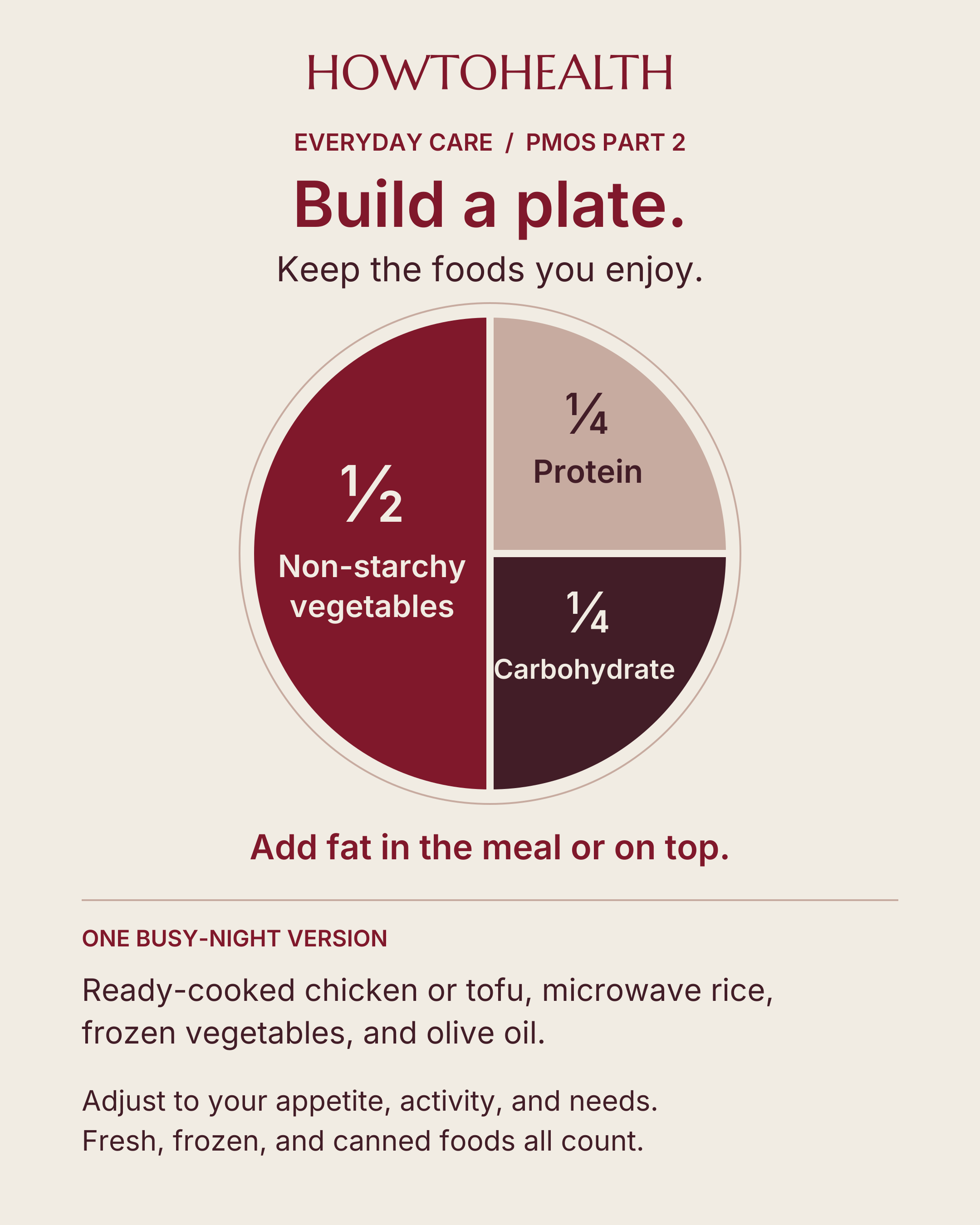
And one question I want you to carry into every meal, because it turns the whole conversation from subtraction into addition: what would make this meal more nourishing? Most women with PMOS have spent years being told what to cut. Start with what is missing, usually protein, fiber, or simply enough food.
Then look at where feeding yourself actually falls apart. These are the three places it happens most, and none of them is a willpower problem.
You get busy, miss a meal, and feel ravenous later. Before making another food rule, make the missed meal easier to eat. If mornings disappear into coffee and work, put breakfast where you will see it: overnight oats with Greek yogurt, fruit, and nuts, or eggs and toast made ahead. If lunch disappears between meetings, pack it when you put dinner away and protect a real break to eat it. Then notice whether eating more consistently changes your hunger and energy later in the day. Cravings have several possible causes; they are not proof of poor willpower or a blood-sugar diagnosis. Dietitian guidance on regular meals
You eat a “healthy” lunch and are hungry an hour later. Check whether it was enough food. A bowl of leaves may need beans, tofu, chicken, or fish; rice, potatoes, or bread; and a dressing you enjoy. A sandwich can be a nourishing lunch. If dinner is hours away, fruit with yogurt or crackers with hummus can bridge the gap. The aim is to feel adequately fed; a smaller lunch was never the assignment.
You buy ingredients with good intentions, and the week gets away from you. Plan for the evenings you actually have. Before shopping, check what is already in the house, pick the one meal that repeatedly causes trouble, and write down a realistic option for it plus one backup that needs almost no preparation. Pasta with a lentil sauce on the quieter night; a frozen meal you like, with a side if you need more food, on the late one.
Keep the foods you enjoy, and build around them. Carbohydrates are fuel. Fiber-rich choices such as oats, beans, whole grains, and whole fruit support digestion and glucose management, and pairing carbohydrate with protein, fiber, or fat slows the rise in blood sugar. The amount and type still matter, and normal rises are part of eating. Rice stays in the meal. A banana is a banana. You do not need to remove gluten or dairy because you have PMOS; an allergy, celiac disease, or an intolerance is a separate question. Honey and maple syrup count as added sugar, and a little in oatmeal or yogurt can make a nourishing meal more enjoyable. Individualized nutrition guidance, Added sugars explained
What I told women in the room. Three things, and every one of them came with permission to be imperfect.
Keep added sugar under about 20 grams a day, and read the label to find it. The American Heart Association’s limit for women is about 25 grams; I set mine a little lower, because the foods that sneak it in are not the ones you expect: flavored yogurt, granola, pasta sauce, salad dressing, bread, and “healthy” bars are some of the worst offenders. The sugar in whole fruit does not count toward it. The Added Sugars line on the nutrition label does the math for you. AHA on added sugars, Reading the Added Sugars line
Make lunch your biggest meal, keep dinner smaller, and finish it about three hours before bed. You need the fuel during the day, when you are using it, and your digestion needs time to work before you lie down. The research here is small but pointed: in a 90-day trial of 60 lean women with PCOS eating the same calories, the group that ate most of them early in the day and had a small dinner cut their insulin response by about half, halved free testosterone, and ovulated more often, while the dinner-heavy group did not change. If you fall asleep within an hour or two of your heaviest meal, that is the pattern I would change first. Meal-timing trial
It’s okay to break the rule on purpose once or twice a week. Dinner out with friends, a late family meal, a birthday: go, eat, enjoy it, and do not spend the next day feeling guilty. Consistency most of the time is what moves the needle. Perfection is not required, and it was never the plan.
Try one adjustment and ask whether meals feel more satisfying and less stressful. If you still struggle to eat enough, if food has become a source of distress, or if you want help with glucose management or weight, a registered dietitian can tailor the next step. You do not have to figure this out alone.
Want more explanations like this? Subscribe free for one women’s health article every Thursday.
Muscle is part of your metabolic care
Well-established: muscle is a major destination for glucose. When it contracts, it can take up glucose through processes that do not depend entirely on insulin’s usual action. Regular activity also helps insulin work more effectively. Muscle glucose physiology
A walk uses muscle while a meal is being absorbed. Strength training builds and maintains tissue that uses fuel. Your muscles belong in the conversation about your ovaries. Benefits can begin before the scale changes.
My starting structure is two or three strength sessions a week, walking, and Pilates or yoga if you enjoy them, with enough food and recovery. Begin with something repeatable: perhaps a five-to-fifteen-minute walk after one meal. Walking research
Bands, dumbbells, or body-weight exercises can work at home. Gradually increase the challenge; a qualified trainer can teach you how. Pain or a physical limitation may call for a physical therapist. No single schedule has been shown to be best for everyone with PMOS, and vigorous exercise can also belong if you enjoy and tolerate it.
If you are consistent but still exhausted, that deserves a closer look. In clinic, I would review sleep, medical history, and whether something such as iron deficiency needed assessment. We would also look at the type and length of the workouts and whether she was eating enough to support them. Sometimes the next step was a shorter, more manageable session.
If this sounds like you, arrange an appointment for persistent or unexplained fatigue, especially if it affects daily life. Bring a short account of how long it has been happening, your sleep, workouts, and eating, and any previous tests. Persistent fatigue deserves assessment even if previous tests were normal; your clinician can decide what further evaluation fits. Fatigue assessment
Sleep is the foundation
My clinical perspective: sleep was the foundation for everything else on the whiteboard. Meals, movement, mood, cravings, and the nervous-system work all got easier when a woman was sleeping and harder when she was not, and no supplement made up the difference. If you only have the energy to protect one thing this month, protect this.
Well-established: short sleep changes how the body handles insulin. In a randomized crossover trial of 38 women, six weeks of about an hour and a half less sleep a night, the kind of short sleep millions of women live with, raised fasting insulin and insulin resistance, and the change did not depend on any change in body fat. For a condition built around insulin, that makes sleep a treatment, not a luxury. Sleep restriction trial
Sleep also shapes appetite and cravings the next day, the energy you have for training, and how well you recover from it. And PMOS can make sleep harder in its own right: sleep apnea is more common with the condition, which is why the guideline tells clinicians to ask about snoring, breathing pauses someone has noticed, and waking unrefreshed. Sleep apnea in the guideline
Here is what I would protect, in this order:
A consistent wake time, seven days a week. It anchors everything else, including when you get sleepy at night.
Enough hours in bed to get seven or more hours of sleep. That is the floor for adults, not a stretch goal. CDC on sleep
Dinner finished about three hours before bed, so digestion is not competing with sleep.
A repeatable wind-down: lights lower, screens away, caffeine finished by early afternoon, and alcohol kept away from bedtime, because it helps you fall asleep and then fragments the second half of the night.
Recovery between demanding workouts. Muscle is built in the rest, not the session.
When sleep needs assessment: loud snoring, breathing pauses, or waking unrefreshed deserve evaluation for sleep apnea. Lying awake most nights, or waking in the small hours and staying awake, for a month or more deserves a conversation with your clinician; cognitive behavioral therapy for insomnia is the first-line treatment and works without medication. Magnesium bisglycinate helped some of my patients settle at night, and it does not fix apnea or a schedule. CBT-I as first-line treatment
Stress, fear, and your nervous system
Being ambitious or a perfectionist is not an established cause of PMOS, and I am not going to hand you one more thing to blame yourself for. I would be leaving something out if I stopped there, though.
Small studies suggest that stress responses differ in some women with PCOS, but they do not establish stress as its cause. Stress research, research in young women
There is also research on helping women feel better. An eight-week trial combining mindfulness-integrated cognitive behavioral therapy with lifestyle support improved anxiety and depression compared with a control group. A newer review found improved PCOS-specific quality of life, although overall anxiety and depression scores did not significantly improve. The findings are mixed, and these structured programs involve more than a breathing exercise. They support taking psychological care seriously; they do not establish a way to reset your hormones. 2025 trial, 2026 review
Clinical observation: underneath a lot of what I saw in clinic was fear: of failing, of not being pretty enough, of not being liked, of dying. That was true whether or not a woman had PMOS, and it shaped how she slept, ate, trained, and recovered. Calming the nervous system was part of care, not a side quest. That does not mean fear caused her condition. Support changed how she felt living in it. That mattered alongside the symptoms and lab results we were following.
When the plan itself becomes stressful
This is where the question from the beginning becomes useful: is the change helping, or is the routine adding pressure? To answer it, look at what is happening in your day.
Here is an illustrative example of how we might adjust it. A woman wants to cook nourishing dinners, but she works full time, spends ages reading labels, and comes home too tired to make the meals she planned. Then she feels guilty about what she eats instead.
Start with the part that is making dinner difficult. If shopping is the barrier, grocery delivery may help. If cooking is the barrier, a box of ingredients still leaves that job to do. Prepared meals or a meal service could be useful if they fit her needs and budget.
A lower-cost starting point could be one dependable dinner assembled from ready-cooked chicken or tofu, microwave rice, and frozen vegetables. Keep those ingredients available for the busiest evenings. She can try the simpler version and ask: am I feeding myself more reliably, with less work and less guilt? If it still costs too much or takes too much effort, we adjust again.
That is the kind of problem-solving I mean. Convenience can belong in a nourishing routine. You do not have to cook every meal from scratch or buy organic food to begin.
New habits can take effort, and progress can take time. But a routine that repeatedly leaves you overwhelmed or ashamed deserves another look. Give yourself credit for what you have changed. Once one part feels manageable, you can decide whether you have room for another goal.
Patience and grace belong in the plan. Learning about your health is already a constructive step; you do not have to turn everything you read into another task tonight.
“Meditate more” is not much of a plan, and I am not going to hand you a morning routine. Pick one moment in your day that repeatedly leaves you tense or overwhelmed, and give that moment one small thing:
When you need a moment to settle: sit comfortably with your feet supported. Breathe gently in through your nose and out through your mouth, counting slowly if that helps, without forcing a deep breath. Try five minutes. If it makes you dizzy or more anxious, stop and return to your usual breathing. NHS breathing exercise
When worry keeps sending you back to your phone: notice the trigger, what you do next, and what happens afterward. For example: a symptom video → more searching → more fear and less sleep. Write down the question for your clinician and choose a stopping point for tonight. This example applies psychiatrist Judson Brewer’s work on recognizing anxiety habit loops. Brewer’s practical explanation
If your feed consistently leaves you feeling worse about yourself, mute or unfollow the accounts that contribute to it, or take a break from the app. You can choose how much space comparison gets in your day.
The practice matters less than the pattern it interrupts. Calming your nervous system is not a side quest, and it is not one more thing to do perfectly. Choose one place to begin. Prayer, gentle yoga, or meditation may also suit you. Some of this work is learning to settle; some is changing the patterns and pressures you return to every day. You do not need perfect calm, and a practice that makes you feel worse is not something to push through. Relaxation guidance and cautions
Anxiety and depression are both common with PMOS, and the international guideline recommends screening every adult who has it. If your mood has been low or your worry constant, tell your clinician. Your mental health deserves a place in your care plan. Guideline on mood
3. Decide what additional support fits
Your gut belongs in the picture, too
Gut microbes and their products are being studied for their connections with insulin signaling, inflammation, and hormones in PMOS. That makes gut health relevant; it does not establish one gut imbalance as the cause.
Some trials of probiotics and synbiotics (a combination of probiotics and prebiotics) report improvements in selected metabolic or hormone measurements. Results vary: a July 2026 review found some benefits but no clear improvement in a commonly used measure of insulin resistance, and a September trial analysis found no clear metabolic benefit over placebo. We do not yet have a proven gut protocol for everyone with PMOS. 2026 review, September 2026 trial analysis
Start with the foods already on your plate: oats, fruit, vegetables, beans, or lentils in amounts you tolerate. Add fiber gradually if you are not used to it; more all at once can worsen gas and bloating. Persistent pain, constipation, diarrhea, or bloating deserves its own assessment. Digestive-health guidance
The gut and brain also communicate. For people with IBS, gut-focused cognitive behavioral therapy or hypnotherapy can help digestive symptoms. That is a reason to ask about appropriate care, not evidence that digestive symptoms are imaginary or that the same treatments cure PMOS. NIDDK on IBS care
A commercial microbiome test is not a required first step. Its usefulness for choosing treatment remains limited; that is different from tests your clinician orders to investigate specific digestive symptoms. International microbiome-testing consensus
What about supplements?
The answer: a few earn a place in care, for reasons that have nothing to do with wellness marketing. Every one below is a nutrient or a compound with known biochemistry, studied in randomized trials, and most are used by endocrinologists, OB-GYNs, cardiologists, and dietitians for jobs well beyond PMOS. Clinicians reach for a supplement when it has a job: filling a measured gap, acting on a pathway we understand, or supporting something the body needs whether or not PMOS is in the picture. None is required to begin, and I never wanted a woman buying a stack before she had a plan.
My clinical perspective: I started using these because of the research, and I kept using them because of what I saw. Women told me they felt better. Cycles became more regular. Blood-sugar measures improved while inositol or berberine was part of their care. I take inositol myself, every day. That experience is real, and it is not proof on its own: those women were also eating, moving, sleeping, and being treated differently, so I cannot tell you how much came from the supplement. What I can tell you is why each one comes up in clinics, not just mine, and what I would want you to know before you buy it.
Inositol: the one I would discuss with most women with PMOS. Myo-inositol and D-chiro-inositol are part of the signals cells use to respond to insulin, and inositol has a role in ovarian function, which is why it is studied for both blood sugar and cycles. A 2023 review of 26 randomized trials found that women taking inositol were about 1.8 times as likely to have regular cycles as women on placebo, with results on that measure not inferior to metformin, and lower glucose, insulin, and testosterone measures than placebo; the placebo comparison for cycles rested on only a few trials. The review that informed the international guideline rated the evidence limited and inconsistent overall, noted that myo-inositol likely causes fewer stomach side effects than metformin, and supports discussing inositol according to your preferences without naming a best form, ratio, or dose. The 40:1 myo-inositol to D-chiro-inositol blend you will see marketed has encouraging results from one small trial. 2023 review of randomized trials, 40:1 trial, guideline review
Berberine: a conversation about blood sugar. Clinicians consider berberine because its effect on glucose handling is measurable: in a placebo-controlled trial in people with type 2 diabetes, it lowered HbA1c, the three-month blood-sugar average. That is why it comes up for PMOS, where insulin is part of the picture, and some PMOS studies have reported metabolic or cycle improvements. An October 2026 review found all four PMOS trials it assessed unreliable, so the size of the benefit in PMOS is not yet known. I used it with a goal and a three-month checkpoint. It is not a substitute for metformin; do not replace prescribed metformin on your own. Digestive side effects and medication interactions matter, and avoid it during pregnancy and breastfeeding. Diabetes trial, evidence review, NIH safety information
Omega-3s: the cardiologist’s supplement, with a hormonal side. Concentrated EPA is a prescription treatment for high triglycerides; that is the clearest clinical use, and the reason omega-3s belong in metabolic care. They matter for hormones too: EPA and DHA are built into cell membranes and into the molecules that turn inflammation up and down, and inflammation and insulin resistance feed the androgen excess in PMOS. A 2023 pooled analysis of seven PMOS trials (574 women) found lower triglycerides, total cholesterol, insulin resistance, and testosterone with omega-3 supplementation, with no change in weight or hair scores and marked variation between trials. Fertility improvement is a separate claim. If you rarely eat oily fish, a fish-oil or algae-based product can fill the gap. Prescription doses differ from an everyday supplement, and routine fish oil has not consistently prevented heart attacks or strokes in generally healthy adults. Check the actual EPA and DHA amounts, not the total “fish oil” on the label. Omega-3 physiology and clinical evidence, 2023 PMOS meta-analysis, PMOS trials
Vitamin D3: the one your clinician may already test. Vitamin D behaves like a hormone: it governs calcium absorption and supports bone, muscle, and immune function whether or not you have PMOS, and low levels are common. In women with PMOS who were low, a small trial found metabolic improvements when levels were corrected. It is not a fertility fix: a large 2026 trial in women with PMOS undergoing IVF found no improvement in live births. My clinical perspective: I aimed for a 25-hydroxyvitamin D level between 50 and 90 ng/mL and rechecked it after three months of supplementing, because the dose that gets a woman there varies. That target is my clinical judgment, not a general recommendation. The NIH notes that 20 ng/mL is sufficient for most people and that levels above 50 ng/mL can be associated with adverse effects. Do not aim for my historical target on your own; agree on a level and monitoring plan with your clinician. The NIH sets 4,000 IU a day as the upper limit for routine use without supervision; higher doses belong under a clinician who is checking your level. Vitamin D is fat-soluble, so take it with a meal that contains fat, or with your fish oil. Vitamin D functions and safety, PMOS metabolic trial, IVF trial
Vitamin K2: the bone-and-calcium rationale. It comes up because so many products pair it with D3. Vitamin K activates proteins that build bone and limit calcium deposits in soft tissue, which is real physiology. In PMOS specifically there is one small eight-week trial. That is not enough to make K2 routine PMOS care or a required partner for every vitamin D supplement, and trials have not shown that the pairing prevents calcium deposits in blood vessels. Your age, diet, bone health, and medicines decide whether it fits. Vitamin K interacts with warfarin. Vitamin K physiology, K2 trial in PMOS
N-acetylcysteine (NAC): a hospital medicine with a metabolic signal. NAC has been used in hospitals for decades as the antidote to acetaminophen overdose and as a treatment that thins mucus in lung disease. It works by supplying cysteine, the building block the body needs to make glutathione, the main antioxidant inside our cells and the molecule the liver leans on to neutralize toxins. Oxidative stress uses glutathione up, and oxidative stress is part of the insulin-resistance picture in PMOS, which is why NAC was studied here. Trials suggest a modest benefit for fasting glucose, and a 2024 trial found more pregnancies when NAC was added to ovulation-induction medication. It did not test NAC alone or show a live-birth benefit, so fertility use belongs in a plan with the treating clinician. Metabolic evidence and rationale, fertility trial
Magnesium: more than sleep. Magnesium is a cofactor in hundreds of enzyme reactions, including the ones insulin uses to move glucose into cells, which is why it is studied in insulin resistance. The PMOS-specific evidence is promising and thin: a small triple-blind trial (40 women, two months of magnesium) found lower insulin and insulin resistance and better cholesterol numbers, with no difference in cycle regularity between groups, and a 2026 pooled analysis of 11 mineral-supplement trials (618 women, magnesium among the minerals) found lower fasting glucose, insulin, and insulin resistance without separating magnesium’s share. One widely cited magnesium combination trial was retracted in 2023, so I would not oversell it. I used magnesium bisglycinate, the form bound to the amino acid glycine, because it is gentle on the stomach and well absorbed, for sleep, recovery, muscle cramps, and as part of metabolic support. Magnesium trial, 2026 mineral meta-analysis, 2025 review
Before adding something, agree on its purpose, how you will assess the response, and when to review it. In my practice, three months was always the checkpoint: long enough for cycles, symptoms, and labs to show a direction, short enough that an unhelpful supplement does not stay on the shelf for a year. For an inositol trial, that meant following cycle dates, a glucose measure chosen with your clinician, tolerability, and how you felt. One returning period does not confirm regular ovulation. A vitamin D plan may instead focus on meeting your needs or correcting a confirmed deficiency. Having PMOS alone does not tell you which supplements you need.
What I take, and how. Women asked, so I put my own regimen on my Fullscript dispensary as a plan you can open without an account. It holds the inositol I take, InosiCare, a 40:1 myo- to D-chiro-inositol blend from Ortho Molecular Products that is only dispensed inside a practitioner’s plan, along with vitamin D3 with K2, fish oil, NAC, magnesium bisglycinate, a blood-sugar support formula, and a few things this article does not cover, including a multivitamin and creatine. It shows the amounts I take. Those are my choices for my body, not a prescription for yours. You do not need all of it, or any of it, to begin; if you have a provider or another source for any ingredient, you do not need to buy through me, because the ingredient is what matters, not the label. InosiCare also contains resistant starch and trace minerals, and the inositol research does not automatically validate every claim for a finished combination. I receive a portion of sales through that link, and that has no bearing on anything written here. If you have a clinician, bring the list to her; the three-month check-in applies to every item on it.
Bring your current products to your clinician or pharmacist so the full ingredients, doses, and interactions can be checked. If side effects develop, ask for advice rather than adding another product to manage them. If the cost crowds out food or other care, revisit the plan. You do not need every supplement on this list, and you do not need any of them to begin.
Who helps you put this into practice?
A PCP or OB-GYN may recommend lifestyle changes while managing diagnosis, bleeding, medications, and pregnancy goals. A standard appointment may not allow time to turn that advice into meals, a beginner lifting routine, and repeated troubleshooting.
A registered dietitian can help with food and your relationship with it. Nourish is one virtual option; check provider fit, coverage, and cost.
A qualified trainer can teach you to strength train safely.
A licensed mental health professional can help with persistent anxiety, body-image distress, disordered eating, and patterns that are difficult to change alone. Ask about experience with PMOS and approaches such as cognitive behavioral therapy.
A licensed functional or integrative clinician may offer longer visits and coordinated follow-up. Ask what is included, how progress is assessed, and what it costs.
You can ask for support at the beginning. If the plan is still difficult to carry out or you are not feeling better, revisit it with the person helping you rather than adding more goals. Ask your current clinician about covered referrals if private care is out of reach. Bring this sentence: “I understand the recommendation. I need help putting it into practice. Who can help me, and what should we follow to know whether it’s working?”
Can this get better?
The answer: yes, and the check-ups stay, whatever your size. Symptoms can improve substantially, and some women no longer meet the same diagnostic features. That may be called remission. The underlying tendency and the need for follow-up can remain.
Come back to the goal at the top of the whiteboard: feel good in your body, and when you don’t, know why. How you feel deserves its own place in the conversation.
At your review, name two or three changes that matter to your daily life. Are you getting through the afternoon with more energy? Sleeping more restfully? Feeling less distressed around food? Recovering better from movement? Then ask whether the routine is helping or adding pressure. Bring those answers alongside the symptoms and clinical measures you and your clinician are following. Feeling better is meaningful, and persistent symptoms still deserve attention even when a lab result looks reassuring.
Hair changes may take months; one returning period does not establish regular ovulation. Keep the missing-period guidance near the beginning of this article in mind: assessment and lining protection should not wait for lifestyle changes to work.
Even when symptoms improve, keep the blood-sugar, cholesterol, and blood-pressure check-ups, whatever your size. As we covered in Part 1, diabetes risk is higher with PMOS at every body size. Heart and blood-vessel disease follows the same pattern. A 2026 study followed 127,517 women with PCOS in Denmark, Finland, and Sweden for about a decade and found heart attacks, strokes, and blood clots about 30 percent more common than in women without the condition. Among women with a BMI under 25 and no diabetes, the figure was about 40 percent. In absolute terms, the Danish figures were about three women per 1,000 each year compared with about two, as the lead author described them. Most women with PMOS will never have one of these events, and the check-ups exist to keep it that way. The point of that number is not fear. It is that these check-ups belong to every woman with PMOS: the guideline says every woman should have her cardiovascular risk assessed, with a cholesterol panel regardless of age or BMI, blood pressure checked yearly, and blood sugar checked at diagnosis and every one to three years after. “But you’re not overweight” is not a reason to skip them. Nordic cardiovascular study, Follow-up guidance
Work, caregiving, fatigue, and cost are real constraints. You did not choose PMOS. A plan that fits your life can help you influence how you live with it.
Leave with one next step
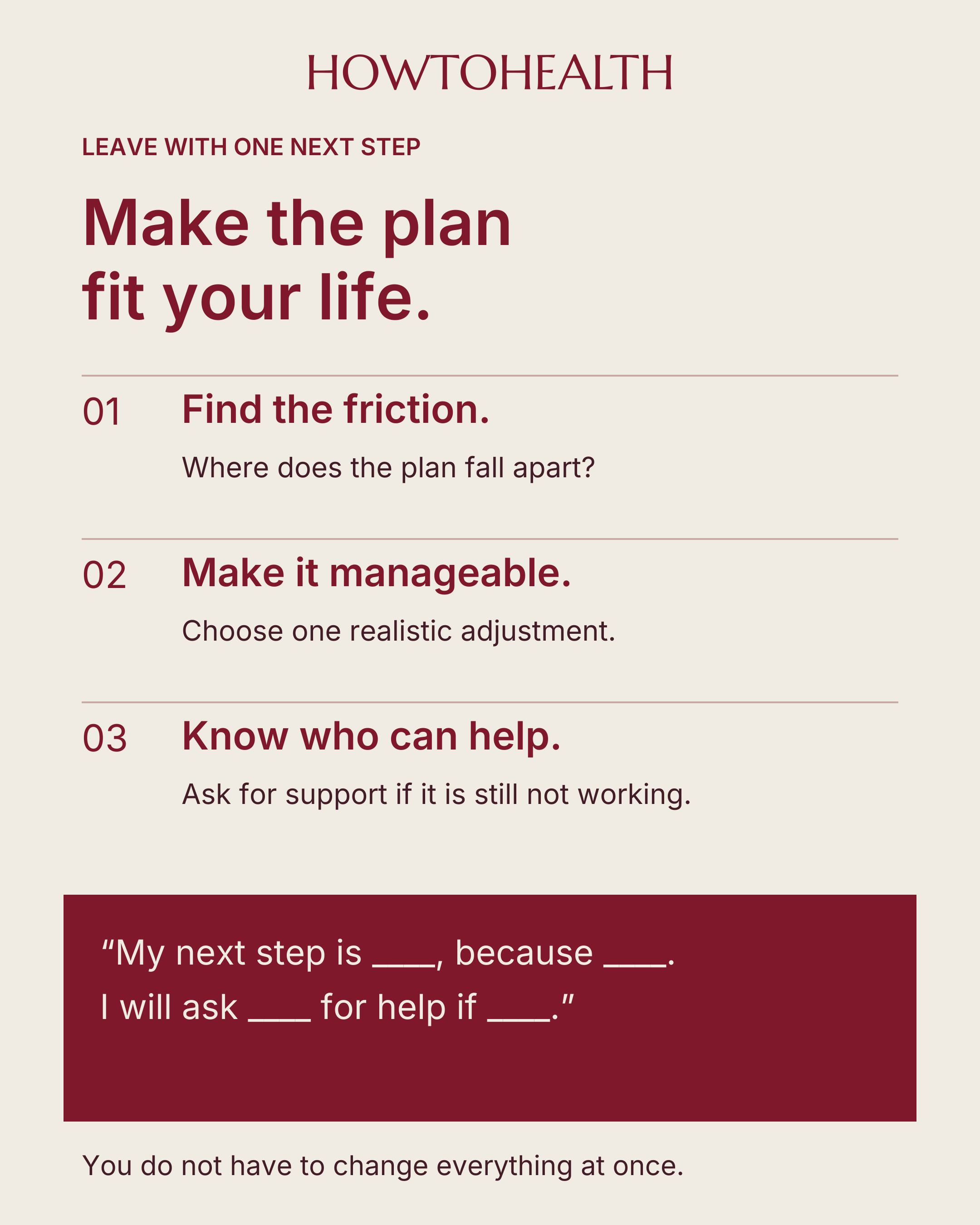
You do not need a complete new routine tonight. Try finishing this sentence:
“My next step is ____, because ____. I will ask ____ for help if ____.”
For the woman struggling with dinner, that could be: “I will keep one easy meal available for busy evenings, because cooking from scratch after work is where my plan falls apart. If I am still struggling to feed myself regularly, I will ask my clinician about a covered dietitian referral.”
Your next step might be an appointment, a question for your prescriber, or support with persistent worry. Asking for help can be the first step; you do not have to earn it by trying harder on your own.
For a daily habit, you might check in after a week to ask whether it fits your life. That is a check on practicality, not a deadline for symptoms or labs to improve. Agree on medical follow-up with your clinician; the reasons to seek help throughout this article take priority.
Know a woman who was told “diet and exercise” and nothing else? She does not need PMOS to use this. Send her this.
Which would help you more next: a deeper PMOS piece on labs, supplements and fertility, or endometriosis?
Congratulations, we’re healthing.
Lindsay Savage, PA-C
Sources & evidence notes
International evidence-based guideline for the assessment and management of PMOS, 2023 recommendations, ASRM-hosted
Endocrine Society — Diagnosis and treatment of PCOS clinical practice guideline, 2013 (PMC5399492)
Joint advisory on nutrition and muscle health with GLP-1 medications, 2025 (PMC12125019); NIDDK — prescription medications for weight management
CDC — Diabetes meal planning; FDA — Honey, maple syrup and added sugars; British Dietetic Association — PMOS and diet, developed with dietitians Claire Pettitt and Dr Linia Patel (page marked under review)
Physiology review of muscle glucose uptake and exercise, 2025 (PubMed 40173020)
DiPietro et al. — Post-meal walking and glucose in older adults, 2013 (PubMed 23761134)
See 28 (sleep restriction trial)
NIH ODS — Vitamin D; omega-3 meta-analysis in PCOS, 2023 (PMC10022207); magnesium systematic review, 2025 (PMC11857371); NCCIH — Berberine
Moran et al. — Impaired glucose tolerance, type 2 diabetes and metabolic syndrome in PCOS: systematic review and meta-analysis, Human Reproduction Update, 2010 (DOI)
Benson et al. — Disturbed stress responses in women with PCOS, Psychoneuroendocrinology, 2009 (DOI)
Mezzullo et al. — Salivary cortisol and cortisone responses to psychological stress in young women with different hyperandrogenic states, Psychoneuroendocrinology, 2018 (DOI)
Reappraising the relationship between hyperinsulinemia and insulin resistance in PCOS, Journal of Endocrinology, 2025 (PubMed)
Wang et al. — Mindfulness-integrated CBT plus lifestyle support in PCOS, randomized trial, 2025 (DOI); Li et al. — Mindfulness-based interventions in PCOS, systematic review, 2026 (PubMed)
NHS — Breathing exercises for stress; Judson Brewer/Brown University — Recognizing anxiety habit loops; Centre for Clinical Interventions — Perfectionism resources; NCCIH — Relaxation techniques
Sun et al. — Probiotic and synbiotic supplementation in PCOS, systematic review, 2026 (DOI); Gorzko et al. — Secondary metabolic analysis of a probiotic trial in PCOS, 2026 (PubMed)
NIDDK — IBS diet and treatment; Porcari et al. — International consensus statement on microbiome testing in clinical practice, 2025 (PubMed)
Perera et al. — Questionable evidence for berberine in PMOS: an integrity-based reappraisal, October 2026 (Full text); NCCIH — Berberine and weight loss: what you need to know
Fitz et al. — Inositol systematic review informing the international guideline, 2024 (Review); Nordio et al. — Small comparison of inositol ratios, 2019 (PubMed)
Vitamin D and metabolic measures in PCOS, randomized trial, 2024 (PubMed); vitamin D before IVF in women with PCOS, multicentre randomized trial, BMJ, 2026 (Trial)
Tarkesh et al. — Vitamin K2 (MK-7) in PCOS, randomized trial, 2020 (Trial); NIH ODS — Vitamin K and omega-3 fatty acids
Liu et al. — NAC and metabolic measures in PCOS, systematic review, 2023 (Review); Fang et al. — NAC added to ovulation-induction treatment, 2024 (Trial)
Zhang et al. — Berberine in type 2 diabetes, PREMOTE randomized trial, 2020 (Trial)
Greff et al. — Inositol is an effective and safe treatment in PCOS: systematic review and meta-analysis of 26 randomized controlled trials (1,691 women), Reproductive Biology and Endocrinology, 2023 (DOI)
Glintborg et al. — Increased prospective cardiovascular disease risk in 127,517 Nordic women with polycystic ovary syndrome: a national cohort study, European Journal of Endocrinology, 2026 (DOI)
Huang and Zhang — Meta-analysis of omega-3 polyunsaturated fatty acids in PCOS, 7 studies, 574 women, Medicine, 2023 (DOI)
Shahmoradi et al. — Magnesium supplementation, insulin resistance and metabolic profiles in PCOS, triple-blind randomized trial of 40 women, Biological Trace Element Research, 2023 (DOI); Ye et al. — Mineral supplements and insulin resistance in PCOS, meta-analysis of 11 randomized trials, BMC Endocrine Disorders, 2026 (DOI); Maktabi et al. 2018 magnesium-zinc-calcium-vitamin D trial, retracted 2023, not used.
Jakubowicz et al. — Effects of caloric intake timing on insulin resistance and hyperandrogenism in lean women with PCOS, randomized trial of 60 women, Clinical Science, 2013 (DOI); American Heart Association — Added sugars; FDA — Added sugars on the Nutrition Facts label
Zuraikat et al. — Chronic insufficient sleep in women impairs insulin sensitivity independent of adiposity changes, randomized crossover trial of 38 women, Diabetes Care, 2024 (DOI); CDC — About sleep; Qaseem et al. — Management of chronic insomnia disorder in adults, American College of Physicians guideline, 2016 (DOI)
Evidence notes: guideline recommendations on lifestyle, metformin and inositol rest on low-certainty evidence and expert consensus, labeled where discussed. The stress studies are small and show altered stress reactivity, not cause. Psychological-intervention findings are mixed; the brief examples here are starting practices, not the full programs tested in trials. Gut-intervention studies do not establish a universal cause or a treatment that works for everyone; changes in laboratory measurements do not establish long-term clinical benefit. The post-meal walking study was in older adults, not women with PMOS. The links between insulin, androgens, and fat tissue do not establish a single cause of weight gain for every woman. The Nordic cardiovascular study is observational and registry-based; it adjusted for obesity and education, but body-mass data were available only for women who had been pregnant and lifestyle factors such as smoking were not recorded, so the figures describe association, not a measured cause, and they are not a prediction for any one woman. My clinical observations and preferences are my account, not efficacy evidence. Improvement during a combined plan cannot establish which part caused it; my recollections are not a measured treatment-success rate. The omega-3 meta-analysis showed marked variation between trials; the magnesium trial was small and short, and the 2026 mineral analysis pooled several minerals. The meal-timing trial was small, 90 days, in lean women, and front-loaded breakfast rather than lunch; my 20-gram sugar target, lunch-as-largest-meal pattern and three-hour dinner window are my clinical practice, not guideline recommendations. My vitamin D target range and three-month recheck are my clinical practice, not a guideline; the NIH upper limit is cited for safety. Commercial note: the Fullscript link goes to a plan on my practitioner dispensary from which I receive a portion of sales; it lists what I personally take and is not individualized advice; the education in this article is complete without any purchase, and every ingredient can be obtained from any provider or source.
This article is for education, not individualized medical advice. Your clinician can recommend care for your circumstances.
I have learned so much from these articles and also from being your patient in the past. These articles have really helped to help me and my daughter further understand all of this. Thank you for your work!
Incredible article! Go girl! 🪄✨🧚🏻