


Reading in your inbox? Open the full article for every graphic and source.
“You’ll never guess what the doctor I had before you told me.”
I heard some version of that sentence often in clinic. When the woman saying it had PCOS, a story about being brushed off usually followed.
Then came the rest. They did not know whether they could still get pregnant. They despised their chin hairs. They were working out and not losing weight. They had tried every diet and no longer knew what was worth buying or investing in. They told me how exhausting all of it was. And many of them did not want to go on the pill, because they wanted to do things as naturally as possible.
Their stories match what researchers have found. In one survey of nearly 1,400 women recruited through PCOS support groups, about a third waited more than two years for a diagnosis, almost half saw three or more health professionals first, and fewer than one in six were satisfied with the information they were given. Diagnosis survey
I don’t think that happens because clinicians don’t care. Most of the clinicians I know are doing their best inside a visit that is too short for a condition that takes time to explain.
About 1 in 8 women has it. If it is not you, it is very likely someone you know, and she may never have mentioned it. I wrote this for both of you. Prevalence
You can bring your acne to one appointment, your missing periods to another, and your blood-sugar results to a third, and still leave without understanding how they connect. “Your hormones are imbalanced” names a problem without explaining it.
Why would a hormone that handles your breakfast have a say in your cycle? How can a lab come back normal when something is clearly wrong? And if birth control makes your bleeding predictable, what has actually changed?
Once you understand the connections, the treatment choices start to make sense.
At the end of Birth Control Part 1, I said I would go deeper into what hormonal birth control can help with in this condition, what it cannot do by itself, and what else I would want on the whiteboard. This is that article.
This is Part 1 of 2. Here we cover what is happening in your body, why I didn’t start with the pill, and what birth control does and does not change. Part 2, next Thursday, is the plan that is in your hands: weight, meals, muscle, sleep, supplements, medication, and who helps you do it.
THE SHORT VERSION
PMOS is the new name for PCOS. It is the same condition. The old name pointed attention at ovarian cysts, which you do not need to have for diagnosis.
Your symptoms can be connected. Insulin, the hormone that helps manage blood sugar, also acts on the ovaries. That is one way periods, skin, hair, and blood sugar end up in the same condition.
The whiteboard has one line at the top and four jobs under it. The line: feel good in your body, and when you don’t, know why. The jobs: help symptoms, support ovulation when you want to get pregnant, protect the uterine lining, and look after blood sugar, cholesterol, and blood pressure.
The pill cannot do all of those jobs. A scheduled bleed on the pill does not show that your own ovulation is regular or that your metabolic health has changed.
Normal labs do not cancel a real symptom. Insulin is not the only thing that turns androgen production up, and chin hair and acne count as evidence.
You did not cause this, and more of the treatment is in your hands than most women are told. Understanding it is the first step; the plan is Part 2.
Why did PCOS get a new name?
The answer: the old name pointed attention at ovarian cysts, and cysts were never required for the diagnosis.
For decades the condition was called polycystic ovary syndrome. In May 2026, after a 14-year international effort that gathered more than 22,000 survey responses, it was renamed polyendocrine metabolic ovarian syndrome, or PMOS. Endocrine Society announcement, ASRM explainer
The new name works as a summary:
Polyendocrine: more than one hormone system is involved.
Metabolic: how your body handles fuel is part of the condition.
Ovarian: ovulation and the hormones your ovaries make are part of it too.
Syndrome: a recognizable pattern of features. You can have the pattern without every feature, and two women with the same diagnosis can have different needs.
How it is diagnosed: in adults, clinicians generally look for two of three features after excluding other causes: irregular ovulation, clinical signs or blood-test evidence of excess androgens, and a characteristic pattern of multiple small ovarian follicles on ultrasound. Some women have all three features, and some only have two. The first two can establish the diagnosis without any ultrasound at all, so a normal ultrasound by itself does not rule PMOS out.
You will still see PCOS on charts and in most research, but I’ll use PMOS from here.
Of note: Adolescents need a different assessment, and thyroid conditions, under-fueling, and other problems can also interrupt periods, so a missing period alone does not tell us the cause. Severe period pain, pain with sex, or bowel symptoms that follow the cycle deserve their own assessment; endometriosis can coexist with PMOS, and one diagnosis should not close the conversation. Diagnostic guidance
What does metabolism have to do with my period?
The answer: more than most of us were told. The same hormones that manage your fuel hand out jobs in your cycle, which is where the next section goes.
Metabolism is the work your body does to turn food into usable energy and building materials, then use or store those resources.
Think of food as a delivery of fuel to your body. Some of that fuel powers what you’re currently doing and some of that fuel is stored for later. It keeps your brain working, your heart beating, and your body functioning, even while you sleep. Your metabolism keeps you alive. Metabolism explained, Using and storing fuel
Metabolic health is about how well your body manages the jobs of creating, using, and storing energy. Hormones sent out by different organs are the managers of metabolism and are dishing out jobs. Think of them as messages between different parts of your body. For example: Your organ, the pancreas, sends the hormone, insulin, to help balance blood sugar. So one hormone (insulin), produced by one organ (pancreas), gives other organs (muscle) a job.
So how are multiple symptoms connected?
How can acne, chin hair, thinning hair, and missing periods be one condition?
The answer: the same hormone message lands differently in different tissues.
In PMOS, the body may need extra insulin from the pancreas to manage blood sugar. Insulin also has a job at the ovaries, and the same insulin that is helping balance your blood sugar can encourage the ovaries to make more testosterone, affecting skin, hair, and egg release. A hormone involved in handling your breakfast can also influence the hormones involved in your cycle. That is one reason chin hair, missing periods, and blood-sugar concerns can belong to the same syndrome. Insulin and ovarian pathways
We need androgens as women. The trouble is that insulin is one signal sent to every tissue at once. Think of a house with one thermostat. One bedroom has bad insulation and never warms up, so you turn the heat up for the whole house, and the rooms that were already comfortable get too hot. In PMOS, muscle is the room that stopped responding well, the pancreas is the hand on the thermostat, and the ovaries are a room that never stopped responding. They get the extra insulin and answer the only way they know how: by making more androgens, the group of hormones that includes testosterone. Androgens can also make insulin work less effectively, so these changes can keep one another going, and women can enter this pattern at different points. Connected symptoms give us several places to help. Research on these connections
Skin and hair: the same message can have different effects. Androgens, including testosterone, can increase skin oil, contributing to acne, and encourage thicker, darker facial hair. On a scalp that is sensitive to these hormones, hairs can instead become thinner. More chin hair and less scalp hair can therefore be connected.
Ovaries: starting the process does not guarantee egg release. A follicle is a small sac containing an egg. It needs to mature and respond to coordinated hormone messages before releasing that egg. Excess androgens and changes in the messages between brain (pituitary gland) and ovaries can interrupt the sequence. Ovarian research, hormone-feedback study
An ultrasound may show many small follicles, with more starting the process than completing it. These differ from large ovarian cysts, and PMOS does not require this ultrasound appearance.
Uterus: no ovulation, no progesterone rise. After ovulation, the ovary makes progesterone, the hormone that tells the lining to stop growing and get ready for a pregnancy. Without ovulation, estrogen keeps telling the lining to grow and nothing tells it to stop. Over months, the lining can become too thick and shed unpredictably, which helps explain long stretches without bleeding followed by a heavy bleed. Over years, a lining that keeps growing without that signal raises the risk of precancerous change and endometrial cancer. The overall chance is low, which is why protecting the lining is a job on the whiteboard rather than a reason to panic. Lining risk in the guideline
One common pathway looks like this:
More insulin needed to manage blood sugar → more ovarian androgen production → less reliable egg release → fewer progesterone rises → less predictable bleeding.
Want more explanations like this? Subscribe free for one women’s health article every Thursday.
How can my blood sugar be normal if insulin plays such a large role?
The answer: a blood-sugar test measures glucose, not how much insulin it took to keep glucose in range, and in PMOS that insulin also acts on the ovaries.
Well-established: glucose is sugar in the blood that the body uses for energy. Insulin, made by the pancreas, helps manage that fuel, including helping muscle take up glucose.
With insulin resistance, some tissues respond less effectively. The pancreas compensates by releasing more insulin, and that extra effort can keep blood sugar in range for a time.
A normal glucose result tells you the level, not the effort behind it.
And the ovaries, as you saw above, keep listening to that extra effort. The same hormone can be less effective at one job and keep stimulating another. That is how a problem with fuel handling becomes a problem with skin, hair, and ovulation.
This is a common pathway, not the starting point for every woman. How common? In the most rigorous studies, which measure insulin action directly rather than estimating it from a blood draw, women with PCOS responded to insulin about 27% less effectively than women without it, at the same weight. Extra weight lowered the response further, but the difference was there without it. Insulin and ovarian pathways, human ovarian-cell research, clamp-study meta-analysis
What if my insulin came back normal too?
The answer: a normal fasting insulin does not rule insulin out, and insulin is not the only thing that turns androgen production up.
Three reasons chin hair and acne can sit next to a normal lab report:
The test is a snapshot from the quietest moment of the day. A fasting insulin is drawn after hours without food, when insulin is at its lowest. In this pattern the extra insulin shows up after meals, and a fasting draw does not always see it.
Insulin is one volume knob of several. Picture androgen production as a speaker with several knobs. Insulin is one. LH, a hormone message from the brain, is another, and in PMOS that message can come more often. The ovary’s androgen-making cells can also carry a built-in tendency to make more: in laboratory studies, cells taken from women with PCOS kept producing extra androgens outside the body. The adrenal glands make androgens too. Your insulin knob can sit at normal while another is turned up. Hormone-feedback study, ovarian-cell research, adrenal androgens in the guideline
The symptom is made at the follicle, not in the test tube. Skin and hair follicles have their own sensitivity and convert testosterone into a stronger form locally, so two women with the same blood level can have different chins. The testosterone test has a blind spot of its own: some testosterone travels attached to a carrier protein, SHBG, which keeps it from acting, and fewer carriers mean more unattached, or “free,” testosterone even when the total testosterone looks normal. Hirsutism guideline
What this tells you: a symptom you can see counts as evidence. The international guideline says unwanted coarse hair on its own should be treated as a sign of excess androgen activity in adults, even without a blood test to confirm it.
Why isn’t insulin tested routinely, then? A reference-standard research test for insulin resistance, called a clamp, involves hours on an IV while a team drips in insulin and glucose and measures how your body responds. It is not practical for routine visits, so simpler estimates are sometimes used: a fasting insulin, or a score calculated from fasting insulin and fasting glucose. When researchers ran the real test and the shortcuts on the same 59 women with PCOS, the two did not line up. A woman could look fine on the shortcut and be insulin resistant on the real test, or the reverse. That is why the international guideline calls the clinic tests “of limited clinical relevance” and leaves them out of routine care; it already treats insulin resistance as part of how PMOS works and recommends daily care for every woman with it, whatever the number says. Guideline on insulin and glucose testing, HOMA and QUICKI against the clamp in PCOS
My clinical perspective: I still checked fasting insulin, and I found it useful for following a woman’s own trend, measured the same way over time, alongside how she felt. I understand the reasoning behind the guideline, and I still think those numbers tell us something. What a single value cannot do is diagnose PMOS or rule insulin out.
So how do we treat it?
PMOS involves both hormone signaling and metabolic health, and the mix differs from woman to woman. For one woman the loudest part is metabolic: her body needs extra insulin, and over time her blood sugar or cholesterol can start to drift. For another it is the ovulation and testosterone side, with irregular cycles, acne, or chin hair, while her standard blood-sugar results look normal. Many women have both.
Still being worked out: which part comes first. Unfortunately, researchers have not settled it, and it may not be the same for every woman. That is why two women with the same diagnosis can need different treatment plans, and why a plan aimed at only one feature can leave the rest unattended. Research on these connections
So here is my treatment whiteboard for PMOS.
At the top, before any job: the point of all of this is for you to feel good in your body, and when you don’t, to know why. The point is to live a full life, not just survive it.
Under it, four jobs:
Symptom control: Help the symptoms you can see and feel: the acne, the hair, the fatigue, the bleeding you can’t predict.
Ovulation: Support ovulation, especially if you want to get pregnant.
Reduce cancer risk: Protect the uterine lining.
Lower the long-term risks: Look after blood sugar, cholesterol, and blood pressure, the job that is easiest to forget because you cannot always feel it.
Why does ovulation matter if I’m not trying to get pregnant?
The answer: two of the four jobs depend on it. Releasing an egg is also what starts your body’s usual progesterone rise, and your uterine lining depends on that rise.
Well-established: your ovaries contain eggs and make hormones. Your uterus grows the inner lining that sheds during a period.
In a typical cycle, hormones from the brain help small egg-containing structures called follicles develop. One usually becomes ready to release an egg. That release is ovulation.
Before ovulation, estrogen helps the uterine lining grow. Afterward, the part of the follicle left behind becomes a temporary source of progesterone, which changes the lining from growing to preparing for a possible pregnancy. If pregnancy does not occur, hormone levels fall and a period follows. Your period is the lining letting go when progesterone falls. No rise, no fall, no true period.
Ovulation does two jobs: it releases an egg and starts the usual progesterone rise. When egg release does not happen, that rise is missing, and bleeding may be absent, delayed, or unpredictable. You can still bleed without ovulating, but that bleeding is the lining giving way, not a true period, and the difference matters when we get to the birth control pill.
Cycle and bleeding explanation. For the anatomy refresher, see Your body, explained.
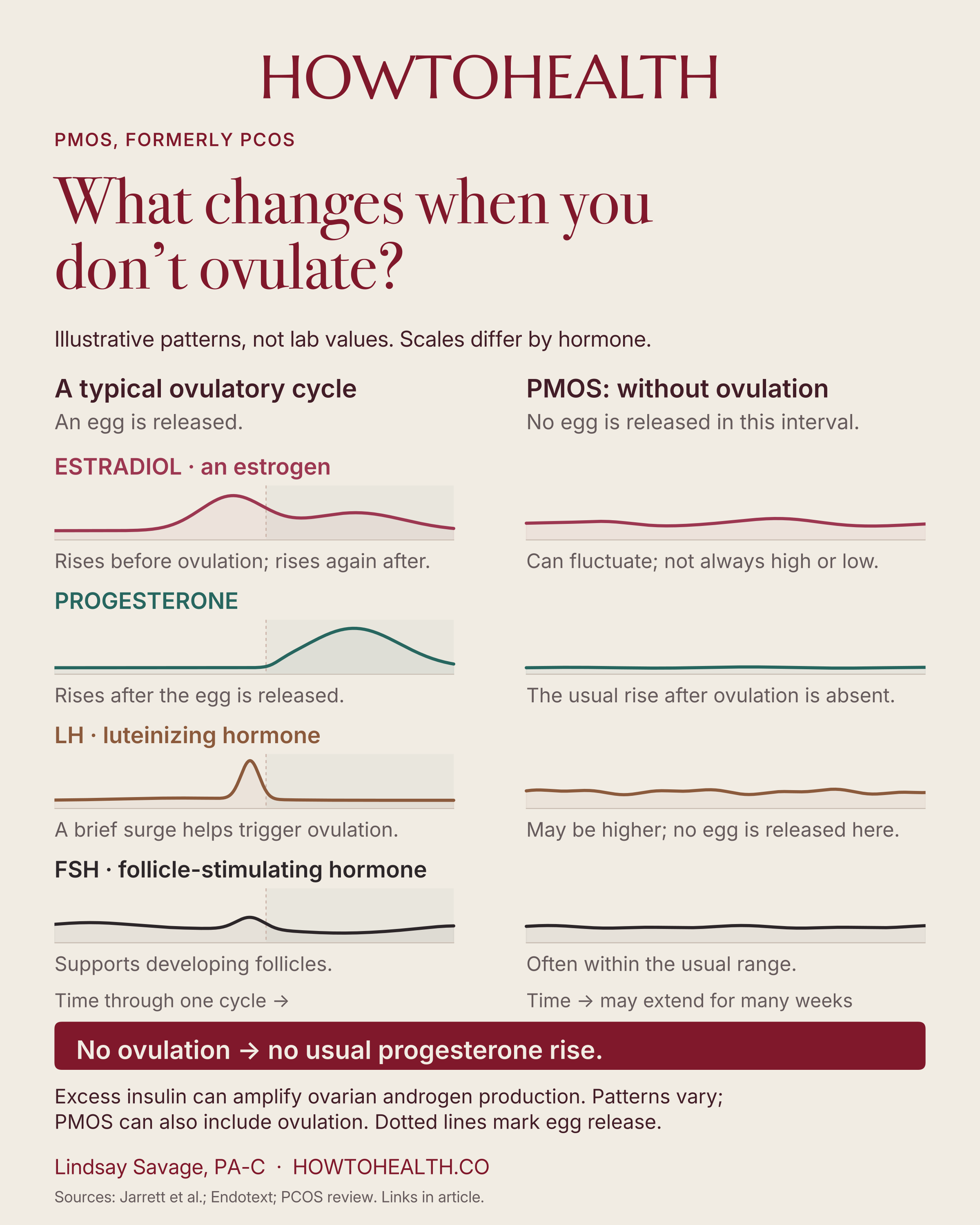
Reading the graphic: Start with the progesterone row: no ovulation means no usual progesterone rise. The other rows add detail. These are illustrative patterns, not measured lab results, and PMOS can include cycles with ovulation too. Cycle physiology, hormone-pattern research
Why do some clinicians start with the pill?
The answer: because for two of the four jobs it is a sensible first move. The international guideline says the combined pill could be recommended for irregular cycles and unwanted hair in adults, and could be used over metformin for those symptoms. It has decades of use behind it, even though the research specifically in PMOS is thinner than you would expect, and skin and bleeding usually respond within a few months; hair takes longer. That is a reasonable choice, not a lazy one. It was not designed for job 4, and it cannot tell you whether your own ovulation has recovered. Guideline on the combined pill
Well-established: the combined pill contains estrogen and a progestin, a medication with progesterone-like effects. It suppresses the brain’s stimulation of the ovaries, prevents ovulation, and reduces ovarian androgen production. Its estrogen also increases the carrier protein SHBG, leaving less androgen free to act. That explains its usefulness for acne and excess hair. The patch and ring work on similar principles, although most PMOS research concerns pills. Mechanism
The progestin helps prevent excessive growth of the uterine lining. Bleeding during a hormone break is withdrawal bleeding: a response to reduced medication hormones.
A scheduled bleed is information about the medication’s effects. It does not show that your own ovulation has recovered.
So, if ovulation matters, why deliberately stop it with the pill?
Without ovulation, the lining gets estrogen’s grow signal without progesterone’s stop signal. With a combined pill, ovulation is paused on purpose while the medication supplies that stop signal. Those are different hormonal situations, and the pill is not a reset button: an “ovarian rest” that cures PMOS has not been demonstrated.
You can relieve symptoms now and work on longer-term health at the same time.
A hormonal IUD is doing a different job
A 52-mg levonorgestrel IUD, such as Mirena, acts mainly in the uterus, thinning the lining and thickening cervical mucus. Some hormone reaches the bloodstream, but ovulation often continues if you were already regularly ovulating. It can improve bleeding and protect the lining; but it does not provide the combined pill’s established treatment for androgen symptoms. With this IUD there may be very little lining to shed, which is different from no bleeding after months without ovulation. The calendar can look the same while the uterus is experiencing something different. Other methods have other jobs; Birth Control Part 2 compares them. Mirena label
The graphic below is meant to help you visualize how two of the most common hormonal birth control methods affect you if you have PMOS.
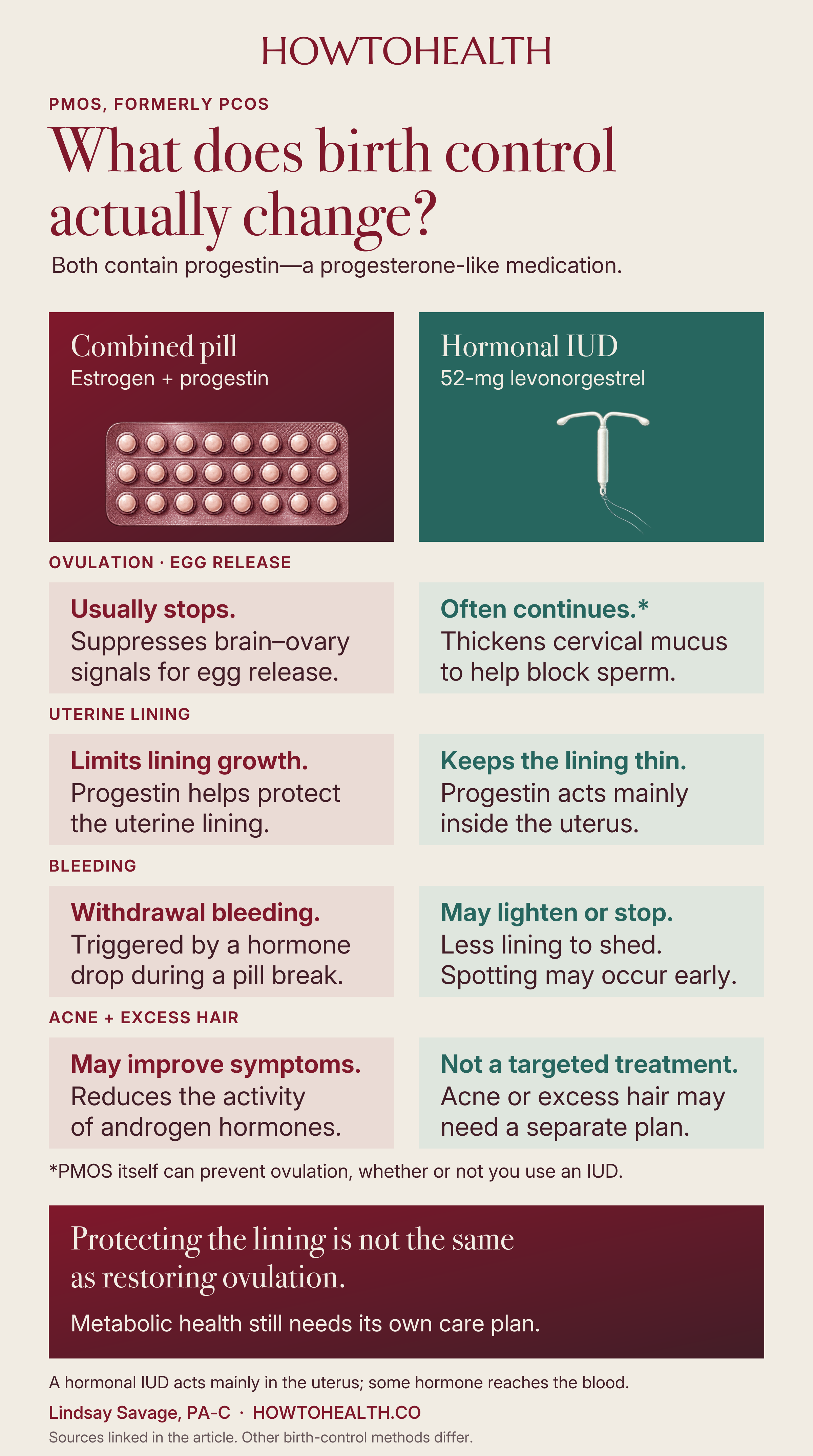
Reading the comparison: Your own progesterone production and a medication’s progestin effects are different. A change in bleeding alone does not show whether ovulation or metabolic health improved. This compares a combined pill with a 52-mg levonorgestrel hormonal IUD; other methods differ. Pill prescribing information, Mirena prescribing information
Why didn’t I start with the pill?
The answer: because of what the pill does and does not do on that whiteboard.
Job 1, symptoms: the combined pill can help acne, unwanted hair, and unpredictable bleeding. Skin and hair can also be treated directly.
Job 2, ovulation when you want to get pregnant: the pill pauses ovulation while you take it. Fertility care exists for this job.
Job 3, the uterine lining: the pill’s progestin helps protect it. A hormonal IUD or periodic progesterone can do this job too.
Job 4, blood sugar, cholesterol, and blood pressure: the pill does not help with these, and over the years this is the job that matters most. A large Danish study found about four times the rate of type 2 diabetes in women with PCOS overall, compared with women without it. Individual risk varies, and screening matters at every body size. Most women with PMOS do not also have diabetes at the time of diagnosis. However, because of the increased risk, it’s important to keep checking your blood sugar: the guideline says every one to three years, and I lean toward yearly. Diabetes risk meta-analysis, Danish registry study, screening guidance
The line at the top, how you feel: for some women the pill does make them feel better, and for some it does not. Either answer belongs in the plan.
My clinical approach: I did not start patients on birth control as my treatment approach when I diagnosed PMOS. I wanted care to address both the hormone symptoms and how the body was handling fuel. A more predictable bleed could help a woman’s daily life while her response to insulin still needed attention. So I started with the jobs the pill was not designed to do: in clinic, I connected symptoms and labs with meals, movement, sleep, recovery, deficiencies, and daily circumstances, then reassessed the response. That time and follow-through are what I value in functional and integrative care.
Clinical observation: I saw symptoms improve, periods return, and pregnancies happen. Several things changed at once in those plans, so I can’t hand the credit to any one of them.
If a patient chose the pill for contraception or symptom relief, I supported that decision and the rest of her plan continued alongside it. What I wanted was a plan that fit the woman in front of me and that she could carry out confidently.
Many of my patients wanted to do this as naturally as possible. That is a legitimate preference, and there is a real plan for it; Part 2 is that plan. It still involves a clinician for a few things: confirming the diagnosis, protecting the uterine lining if periods stay away, and following blood sugar, cholesterol, and blood pressure over time.
You can treat acne and unwanted hair directly, too
If you decline the pill, you still have options for symptom relief alongside metabolic care. A clinician can help choose acne treatments applied to the skin, such as azelaic acid, based on your skin and pregnancy plans. For unwanted facial hair, laser hair reduction may help when a qualified provider selects the device and settings for your skin tone and hair color; PMOS may require more sessions. Anti-androgen medication such as spironolactone is another option a clinician may raise; it requires reliable contraception because it can affect a male fetus. None of these require you to wait until your labs or cycles improve. AAD acne guidance, hair-reduction and anti-androgen guidance
The same guideline tells clinicians to treat unwanted hair as important however minor it looks to them. If it bothers you, it counts.
If you want to come off birth control
Plan it with your clinician: contraception if pregnancy is not wanted, and follow-up of your own cycles, since ovulation can return before the first period. Stopping removes the device or pill’s effects; ovulation problems or androgen symptoms may still need treatment afterward, and continuing an appropriate method is also a valid choice. Contraception guidance
Off hormonal treatment and roughly three months without a period? Take a pregnancy test if pregnancy is possible and arrange assessment. Lining protection should not wait for nutrition changes or supplements to work. Care guidance
Can I still get pregnant?
The answer: often, yes, naturally or with help.
If you have been afraid you cannot, here is what the international guideline tells clinicians to say: women with PMOS should be reassured that pregnancy can often be achieved, naturally or with assistance. If you want to get pregnant and ovulation is irregular, seek help while you work on the rest of the whiteboard. You do not have to perfect your lifestyle first. Fertility care may include oral medication such as letrozole; it does not automatically mean IVF. Fertility guidance, letrozole trial
Two practical notes. Irregular cycles do not reliably prevent pregnancy, so if you do not want to be pregnant you still need a plan. And when you do, the guideline recommends a blood-pressure check and a glucose tolerance test before trying, because PMOS raises the risk of blood-pressure and blood-sugar problems in pregnancy; knowing early is what lets you and your clinician plan for it.
Did I cause this?
The answer: no.
There is no single proven starting cause for every woman. An inherited tendency can affect both ovarian hormones and how the body handles fuel. Symptoms often come into view around puberty; diagnosis may happen much later. Stopping birth control can reveal symptoms that were less visible while taking it. Genetics, onset and possible causes
Sleep, activity, other conditions, and body fat can affect how strongly the pattern shows up. PMOS can also make weight management harder, and women in smaller bodies can have it. Part 2 takes on weight directly.
Being ambitious or a perfectionist is not an established cause of PMOS, and I am not going to hand you one more thing to blame yourself for. Stress and fear do shape how a woman sleeps, eats, trains, and recovers, which is why the nervous system gets its own place in Part 2.
We can ask: What is contributing now, and what can we change? We do not need to go back in time to help you.
Having ways to influence a condition does not mean you caused it.
If this is not your diagnosis
You almost certainly know someone living with it. Now you know what she is managing: a condition that can reach her cycle, her skin and hair, her mood, and her long-term health, that she did not cause, and that may have taken years to get named.
A few things that help:
Believe her. Many of the women I saw had been brushed off before they reached me.
Skip the weight advice. Weight management can be harder with PMOS, and many women with it report weight stigma, including in healthcare.
Don’t assume anything about her fertility. Pregnancy is often possible, and the subject is hers to raise.
Let her choose her plan. The pill, metformin, daily routines, or a combination can all be reasonable choices.
Know a woman who was handed the pill without the explanation? Send her this.
Next Thursday, Part 2: the plan that is in your hands. We’ll cover why weight is harder with PMOS and what actually helps, where metformin helps, what it cannot do alone, and why the daily foundations still matter. Then we’ll get practical about the plate, the muscle, the sleep, the few supplements with a purpose, and who helps you do it.
Which connection was new to you: insulin and the ovaries, a scheduled bleed not proving ovulation, or a normal lab next to a real symptom?
Congratulations, we’re healthing.
Lindsay Savage, PA-C
Sources & evidence notes
Endocrine Society — Polyendocrine Metabolic Ovarian Syndrome: new name announcement, May 12, 2026
ASRM — PCOS is now PMOS: understanding the name change, May 27, 2026
Gibson-Helm et al. — Delayed diagnosis and a lack of information associated with dissatisfaction in women with PCOS, Journal of Clinical Endocrinology & Metabolism, 2017 (DOI)
International evidence-based guideline for the assessment and management of PMOS, 2023 recommendations, ASRM-hosted
WHO — Endometriosis fact sheet
MedlinePlus — Metabolism; Metabolic disorders
Reappraising insulin resistance and hyperinsulinemia in PCOS, 2025 review (PMC11906131)
Cassar et al. — Insulin resistance in PCOS: meta-analysis of euglycaemic-hyperinsulinaemic clamp studies, Human Reproduction, 2016 (DOI)
Diamanti-Kandarakis et al. — Failure of mathematical indices to accurately assess insulin resistance in lean, overweight, or obese women with PCOS, Journal of Clinical Endocrinology & Metabolism, 2004 (DOI)
Human ovarian theca-cell research on insulin and androgen production (PubMed 9626131)
Clinical review of cycle and bleeding patterns, 2024 (PMC10833093)
Endotext — Physiology of the normal menstrual cycle (NBK279054)
Jarrett et al. — Ultrasound characterization of disordered antral follicle development in women with PCOS, Journal of Clinical Endocrinology & Metabolism, 2020 (PMC7473602; DOI)
Endocrine Society — Evaluation and treatment of hirsutism in premenopausal women, 2018 (DOI)
Ovarian theca-cell research (PubMed 15514033); hormonal-feedback study (PubMed 11095431)
Multi-ancestry genetic study of PCOS, 2025 (PubMed 41188533); NICHD — PCOS causes
Moran et al. — Impaired glucose tolerance, type 2 diabetes and metabolic syndrome in PCOS: systematic review and meta-analysis, Human Reproduction Update, 2010 (DOI)
Rubin et al. — Development and risk factors of type 2 diabetes in a nationwide population of women with PCOS, Journal of Clinical Endocrinology & Metabolism, 2017 (DOI)
AAD — Acne guideline
DailyMed — combined pill prescribing information; Mirena prescribing information
FSRH — Combined hormonal contraception guideline, amended October 2023
Legro et al. — Letrozole versus clomiphene for infertility in PCOS, New England Journal of Medicine, 2014
Evidence notes: cycle and insulin physiology are well-established. The “four times” figure describes the overall rate in an 11-year Danish registry study, where diabetes was diagnosed in about 8 of every 1,000 women with PCOS per year versus 2 of every 1,000 without it. It is not a lifetime risk or a fixed multiplier for every weight group. The clamp figure is an average difference in insulin sensitivity. The diagnosis survey was recruited through support groups and describes experience, not prevalence. My clinical observations and preferences are my account, not efficacy evidence.
This article is for education, not individualized medical advice. Your clinician can recommend care for your circumstances.