


Your phone warns you at 20%. It doesn’t wait until it dies. Low power mode helps it keep running while you find a charger.
Your body can do something similar with iron. Your stores can run low while your blood count still looks normal. On September 16, the American Society of Hematology (ASH) announced new guidance on when those stores should be considered low.
Here’s what changed, which test to look for, and what to ask next.
The 30-second version
Ferritin estimates your stored iron. It isn’t included in a CBC, the routine blood count.
ASH suggests a ferritin level of 30 ng/mL or lower to diagnose iron deficiency in most adults. A cutoff of 50 ng/mL or lower may be appropriate in higher-risk situations, including heavy periods.
A result needs context. Symptoms, inflammation, pregnancy and ongoing blood loss can change its interpretation.
Find your result and bring it to your clinician. Don’t start iron supplements on your own.
“My blood work was normal.” Which tests?
Well-established: These tests answer different questions.
CBC (complete blood count): Measures hemoglobin, the iron-containing protein in red blood cells that carries oxygen. A low hemoglobin level means anemia.
Iron panel: A group of tests that looks at iron circulating in your blood and how it’s being transported.
Ferritin: Estimates how much iron you have stored. It isn’t included in a CBC, and not every iron panel includes it, so check which tests were ordered.
Your iron stores can become low while your hemoglobin level remains normal. That’s iron deficiency without anemia. Think of ferritin as a battery check, not a literal percentage. A normal blood count doesn’t tell you whether your iron reserve is low.
Why I care about this
I thought my low energy was just not enough sleep. My mom got me a sweatshirt that said “Nap Queen” because I was always looking for an opportunity to sleep. My friends in high school knew I was sleeping if I wasn’t responding in the group chat.
We thought I was just super busy, but it turned out I had iron-deficiency anemia. My heavy periods, overtraining and nutrition were all part of it.
I went digging through my old medical records because I wanted to show you what this looked like in my own labs, before I started taking iron.
My hemoglobin was marked “normal.” My ferritin was 11 ng/mL, flagged low.
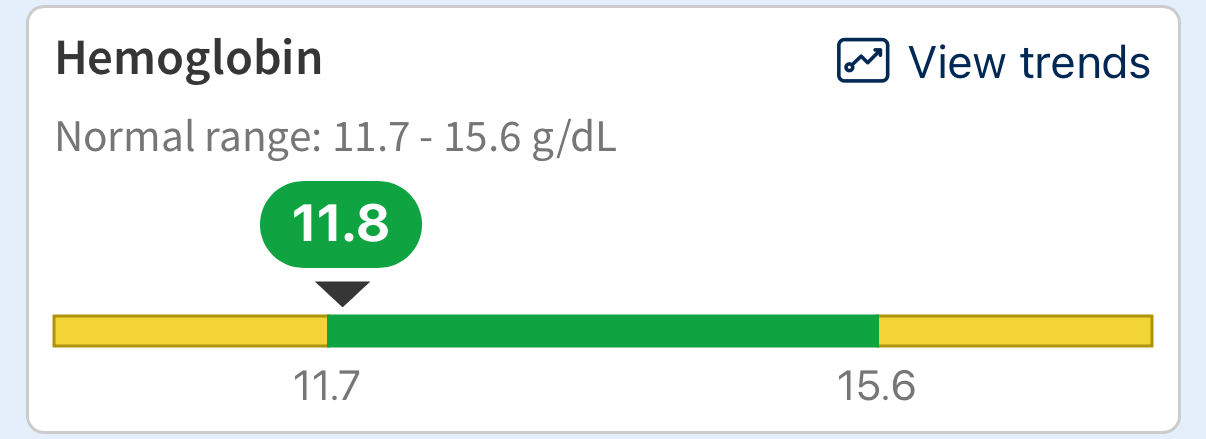
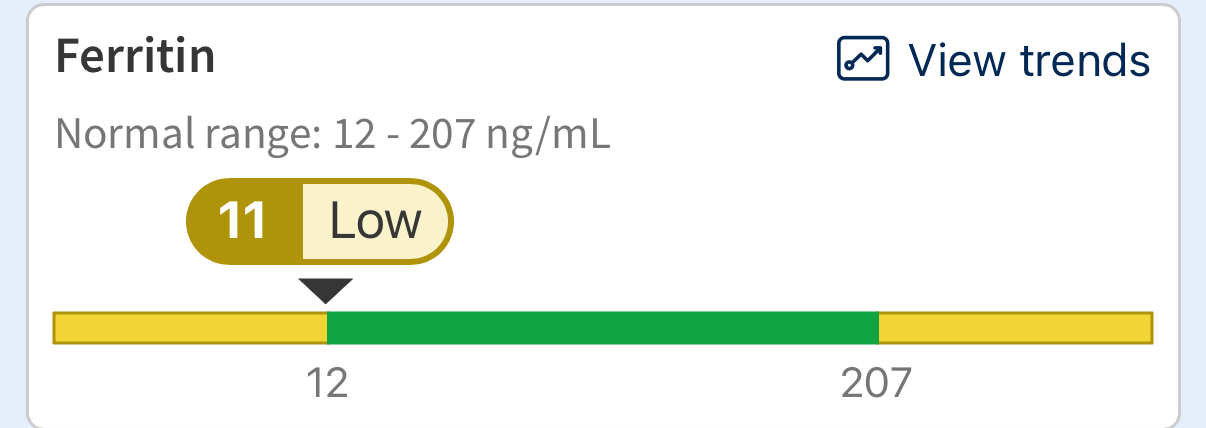
From my records before I started iron. My hemoglobin, 11.8, sat just inside that lab’s range, so it was flagged green. A lab’s reference range isn’t the only cutoff clinicians use, and that flag alone doesn’t rule out anemia. My ferritin, 11, was already flagged low.
I’m grateful my provider ordered ferritin when I told them about my very heavy periods. They looked beyond the blood count, and that mattered.
Clinical observation: I carried that experience into practice, especially when caring for adolescent patients and tired moms. I wanted to understand their fatigue, ask about their periods, and consider whether we needed to check their iron stores.
I wish my own stores had been checked after my periods started. Maybe we would have caught the deficiency before I spent so long assuming I was just busy and needed more sleep.
That’s why earlier screening is personal to me.
Should we check before someone feels exhausted?
Screening means checking for a problem before symptoms prompt testing.
Current evidence suggests: The American Academy of Pediatrics’ 2026 guidance recommends screening adolescents who menstruate for iron deficiency and iron-deficiency anemia:
What to check: A CBC and ferritin.
When: At least one year after the first period, but no later than age 14.
Your clinician may add an iron panel if they need more information, especially when inflammation makes ferritin harder to interpret.
Symptoms or heavy bleeding deserve assessment sooner; routine screening isn’t a reason to wait.
If you’re an adult and don’t know whether your ferritin has been checked, ask your primary care clinician or gynecologist whether testing makes sense for you, especially with heavy periods, persistent fatigue or other risk factors.
What actually changed?
ASH, the professional society for blood specialists, suggests a higher diagnostic cutoff than the long-used World Health Organization cutoff of 15 ng/mL for otherwise healthy adults.
Current evidence suggests:
Most adults: ferritin of 30 ng/mL or lower. This includes women who get periods and women who are pregnant.
Higher-risk situations: 50 ng/mL or lower may be appropriate. Examples include heavy periods, symptoms consistent with iron deficiency, ongoing blood loss, planning pregnancy, or pregnancy with anemia.
The units, ng/mL, mean nanograms per milliliter.
These numbers help identify iron deficiency. They aren’t instructions to get your ferritin to exactly 30 or 50 and then stop treatment. Your clinician should explain what improvement they’re looking for and how you’ll decide whether to continue, change or stop it.
ASH calls its suggested thresholds conditional because the supporting evidence is limited. It makes a strong recommendation against using the old 15 cutoff in pregnancy. Some earlier specialty guidelines already used higher cutoffs; this guidance aims to make diagnosis more consistent.
Inflammation can raise ferritin and hide low iron stores. When inflammation contributes to anemia, ASH suggests checking ferritin alongside transferrin saturation, another blood test that helps assess iron availability.
Lab methods and reference ranges vary. A result marked “normal” can still deserve a closer look alongside your symptoms and history.
Want more explanations like this? Subscribe free for one women’s health article every Thursday.
What can drain your iron?
Well-established risks include:
Blood loss: Heavy periods, childbirth, frequent blood donation or bleeding elsewhere.
Higher needs: Pregnancy and intense endurance training.
Not getting or absorbing enough: Too little iron in your diet, conditions that affect absorption, weight-loss surgery, or long-term acid-reducing medicines.
Finding the cause matters whether or not you get periods. After menopause, low iron should not simply be assumed to be a dietary problem.
Is my period heavy?
It’s hard to judge “heavy” when the only period you’ve ever had is your own.
Well-established: The CDC lists these signs:
Changing a pad or tampon in under two hours, or soaking through one every hour for several hours.
Doubling up on protection or changing it overnight.
Bleeding for more than seven days.
Passing clots the size of a quarter or larger.
Bleeding that gets in the way of your normal plans.
If these sound familiar, bring them up. Heavy bleeding since your first period can be a clue to a bleeding disorder. Periods can change around menopause; a change still deserves attention.
Get emergency care if you’re soaking through a pad or tampon every hour for more than two hours and have chest pain, trouble breathing, or feel dizzy or lightheaded.
If your iron is low, what comes next?
Well-established: Treatment should address both the deficiency and its cause. If heavy periods are draining your iron, treating the bleeding matters, too.
Food contributes iron:
Meat, poultry and fish provide heme iron, a form your body generally absorbs more easily.
Beans, lentils, leafy greens and fortified cereal provide nonheme iron. Pairing these with vitamin C foods, such as peppers or citrus, helps absorption.
Food alone may not correct an established deficiency. If iron is prescribed, ask about constipation or nausea before side effects become the reason you stop. Some women need longer-term or repeated treatment because blood loss or an absorption problem continues.
Current evidence suggests: Iron treatment can modestly improve fatigue in some iron-deficient adults without anemia. Fatigue has other causes, too. If the deficiency is corrected and you still feel exhausted, keep looking with your clinician.
Your appointment checklist
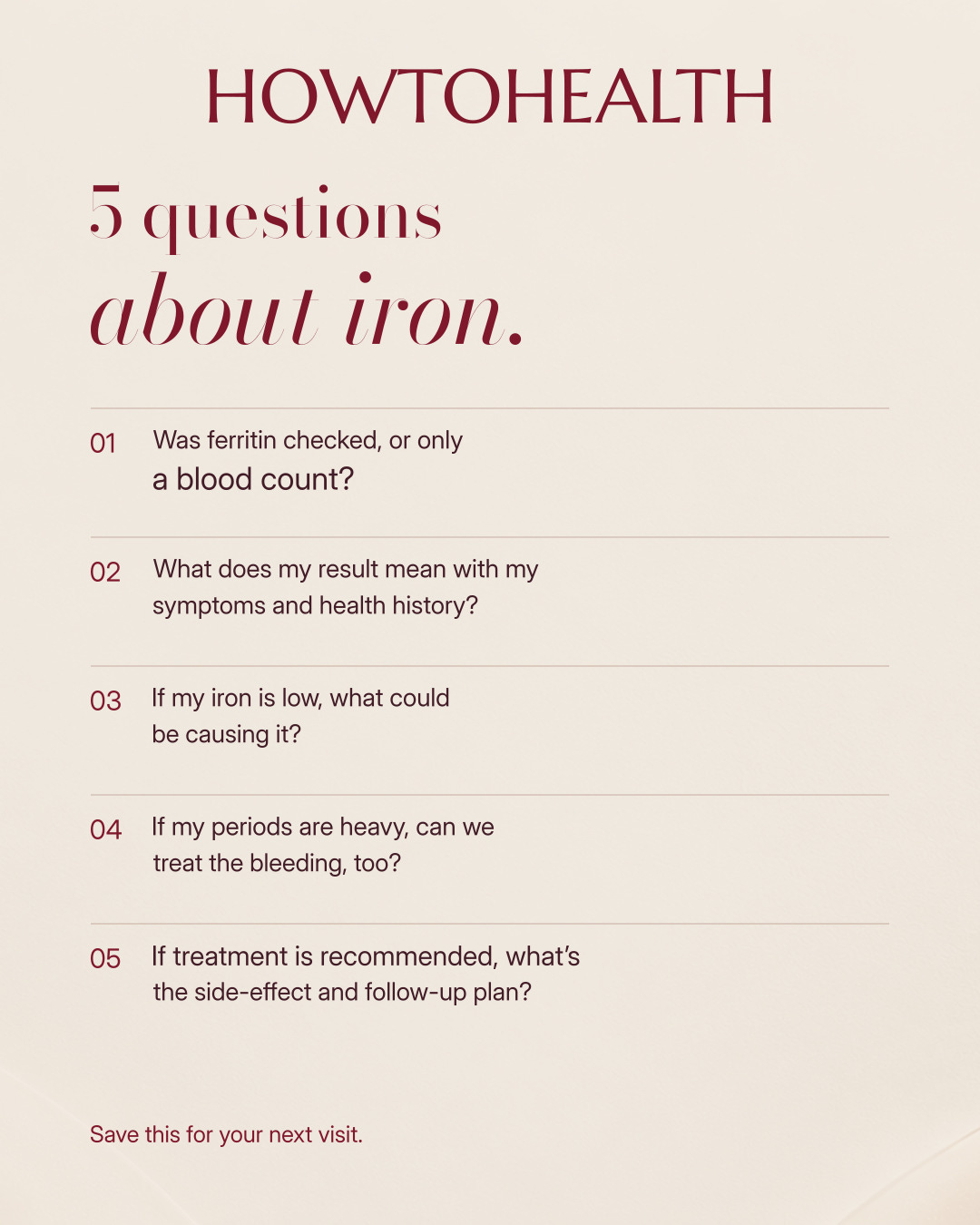
Save this for your next visit. Find your last labs in your patient portal, or ask the office for a copy. If you don’t see ferritin, ask whether it was checked. An old result tells you where you were, not necessarily where you are now.
“Was ferritin checked, or only a blood count?”
“What does my result mean with my symptoms and health history?”
“If my iron is low, what could be causing it?”
“If my periods are heavy, can we treat the bleeding, too?”
“If treatment is recommended, what’s the side-effect and follow-up plan?”
Bring the result and date, your symptoms, medications, and a record of your bleeding if you get periods.
Before testing: If an iron panel is ordered, ask about fasting and when to take any supplements you already use. CBC and ferritin alone generally don’t require fasting.
If treatment starts: Ask when to repeat labs and review symptoms and side effects. Leave with a follow-up plan.
Don’t start iron supplements on your own. Too much can be harmful, and some people have conditions that cause iron overload. Accidental overdose is dangerous, especially for children. Store supplements out of their reach.
You don’t need to memorize every cutoff. You need to know which test was checked, what your result means in context, and what happens next.
Send this to the friend who’s always tired. She knows who she is.
Tell me in the comments: what were you told when you said you were tired? Pick one, or tell me what I missed:
“It’s just stress.”
“You’re not getting enough sleep.”
“It’s just your period.”
“Your labs look normal.”
Then read a few of the other comments. You may recognize your own experience. Please don’t post your own lab numbers here. Unfortunately, I can’t interpret individual results in the comments, but your clinician can.
Coming next: The birth control pill, PCOS (now also called PMOS, polyendocrine metabolic ovarian syndrome), and endometriosis. What the pill can and can’t do for these conditions, and what nobody explained along the way.
Subscribe free so the series lands in your inbox.
Congratulations, we’re healthing.
— Lindsay
Sources & evidence notes
Personal experience and clinical observations are labeled separately from research findings.
ASH 2026 guideline for diagnosing iron deficiency. Published online August 24; announced September 16, 2026. Adult thresholds, risks and inflammation. Diagnostic cutoffs are not universal treatment targets. Implementation tool.
WHO ferritin guideline and 2024 hemoglobin criteria. Laboratory reference ranges and clinical decision thresholds can differ; a normal flag does not establish absence of anemia.
AAP 2026 clinical report and the lead author’s screening summary. Adolescent screening with CBC and ferritin, separate from ASH’s diagnostic guideline.
Houston et al., 2018 systematic review. Modest average fatigue improvement; objective exercise measures did not consistently improve.
NIH Office of Dietary Supplements: Iron. Food, absorption, side effects and risks.
CDC: Heavy menstrual bleeding and ACOG: Abnormal uterine bleeding. Bleeding patterns and emergency-care guidance.
British Society of Gastroenterology guideline. Investigating causes, treatment and follow-up.
Mayo Clinic: CBC preparation, ferritin preparation, and iron-panel preparation. Follow the ordering clinician’s and laboratory’s instructions.
FDA iron warning guidance. Accidental overdose and child safety.
Endocrine Society: PCOS name-change announcement. PMOS terminology.
This article is for education, not individualized medical advice. Your clinician can interpret your results and recommend care for your circumstances.
The guideline updates are huge. I had a ferritin level of 11 and my doctor more or less shrugged. “Try some supplements for a few months” — I think we can do better!