


Your cholesterol has gone up even though your routine barely changed. Or your results look fine, and you’re wondering whether that means your heart is healthy.
The short version
Your body needs cholesterol. Problems can develop when the particles carrying it get stuck inside artery walls and help form plaque, a fatty buildup.
A cholesterol test cannot show whether you already have plaque. Blood tests give clues about risk, scans show particular features of the heart or arteries, and tests of heart function show how it performs. A normal result has meaning within what that particular test measures.
The same cholesterol number can mean different things for different women. Blood pressure, smoking, diabetes, inherited risk, and health history help determine which prevention steps are likely to help most.
Lipids are fats and fat-like substances. A lipid panel, often called a cholesterol test, measures cholesterol and triglycerides, a fat your body uses for energy. It is used to assess risk and track treatment.
Let’s follow the cholesterol first. The reference at the end is optional, for when you want details about a specific test or treatment.
Follow the cholesterol
Your heart is a pump. Electrical signals time its beats, valves keep blood moving forward, and coronary arteries bring oxygen-rich blood to the heart muscle. We’re following atherosclerosis, fatty buildup called plaque inside artery walls. It is one form of cardiovascular disease, the broader term for heart and blood-vessel disease.
Well-established: your body needs cholesterol to build the barriers around its cells and make hormones, vitamin D, and bile acids that help digest fat. The liver, intestine, and other cells make it from small carbon building blocks. You can make what you need without eating cholesterol. Physiology
Cholesterol needs a ride because it does not mix with watery blood. It travels inside tiny carriers called lipoproteins. Think of delivery vans, with cholesterol as the boxes inside. LDL, short for low-density lipoprotein, is one kind of van. Cholesterol is what it carries.
The liver sends out carriers rich in triglycerides. As muscle and fat tissue take up that fuel, some carriers become LDL. LDL receptors, docking sites on liver cells, pull LDL out of blood.
There is a recycling route too. The liver sends cholesterol and bile acids into the gut in bile, a digestive fluid. The intestine absorbs cholesterol from food and bile. Most bile acids return to the liver; some leave in stool. That route will matter when we get to fiber. Transport
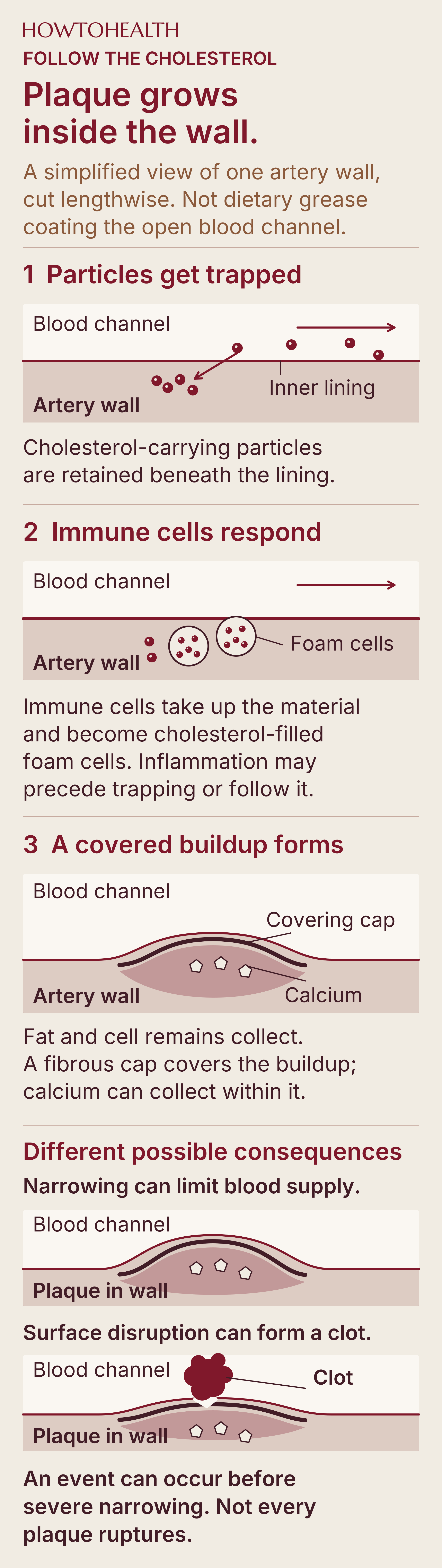
Trouble can begin when carriers enter an artery wall and get stuck beneath its lining. Trapped material can change and trigger inflammation, part of the body’s response to damage or irritation. Defense cells called macrophages take in the trapped material. As they fill with cholesterol, they become foam cells. Over time, fat and the remains of dying cells collect in the wall. Other cells build a covering over this buildup, called a fibrous cap. Calcium can collect in plaque too.
Inflammation does not always have to happen first. It can already be present in an artery wall, but trapped carriers can also trigger it. That inflammation can then help plaque grow. Plaque biology, human artery study
Plaque can narrow an artery enough to limit blood supply during activity, or grow outward while leaving room for blood to pass. If its cap breaks or its surface wears away, a clot can abruptly block flow. What you might find shocking is that your arteries don’t need to be nearly blocked beforehand for a heart attack (myocardial infarction) to happen. Atherosclerosis
What are these blood tests actually measuring?
You can have your cholesterol checked for years without ApoB or Lp(a) ever being measured. Here is what those additional tests can tell you. Standard panel, additional tests
First, your result reflects a balance: how much cholesterol your body makes, how much your gut absorbs, and how much your liver removes from the blood. Food matters, but so do inherited genes, thyroid problems, how your body handles blood sugar, medicines, and pregnancy. Eating well cannot guarantee an unchanged result. Sleep and stress matter too, but cannot automatically explain an individual rise. Causes, evaluation, sleep research
LDL-C: how much cholesterol is inside the LDL vans?
The C stands for cholesterol. LDL-C measures how much cholesterol is inside the LDL vans in your blood, not how many vans are carrying it.
ApoB: how many carriers could contribute to plaque?
Imagine the same small amount of blood from two women:
One has 10 LDL vans carrying 10 boxes each.
The other has 20 LDL vans carrying 5 boxes each.
Both have 100 boxes. Their LDL-C results could look the same, but the second woman has twice as many vans. More carriers, circulating over more years, means more opportunities for them to enter an artery wall and get stuck.
Apolipoprotein B, or ApoB, is a protein attached to each of these carriers: one per carrier. Measuring it helps estimate their number. It includes LDL and other types that can contribute to plaque, including Lp(a). Particles is another name for these tiny carriers. You may also hear them called atherogenic, which means capable of contributing to plaque. Why the count matters
HDL-C and triglycerides: what else is being carried?
HDL, high-density lipoprotein, helps move cholesterol toward the liver to be reused or removed. These carriers are not included in the ApoB count. HDL-C measures the cholesterol inside those carriers, not how well that return system works.
Triglycerides are energy fuel carried in the blood too. A triglyceride-to-HDL ratio divides one result by the other. Even a favorable ratio cannot show that your arteries are clear or make high ApoB unimportant. Transport, ApoB guidance
Lp(a): how much of this particular carrier do you have?
Lipoprotein(a), or Lp(a), pronounced “L-P-little-a,” resembles LDL with an extra protein attached. Its level is largely determined by genes passed down in your family. A high level can increase risk even when other cholesterol numbers look reassuring.
Lp(a) has ApoB too, so it is part of that overall estimate. But ApoB cannot tell you how much of the total is Lp(a). That takes a separate test.
Check the units: mg/dL measures mass; nmol/L reflects the number of particles in a volume of blood. Common cutoffs that add concern about risk are 50 mg/dL and 125 nmol/L. They are separate thresholds, not a fixed conversion, because particle sizes vary. Risk rises across a range, rather than starting at one exact number. Lp(a) and measurement guidance
Why am I only hearing about these tests now?
The usual panel reports total cholesterol, LDL-C, HDL-C, and triglycerides. ApoB and Lp(a) generally need separate orders. “Cholesterol normal” does not tell you whether either was checked.
These tests are not new, but recommendations about using them have expanded. The 2026 U.S. heart-society guideline recommends Lp(a) at least once in adulthood. ApoB can be useful more selectively, including when diabetes or high triglycerides make the usual numbers less informative. Standard testing, current guidance
ApoB may reveal more plaque-contributing carriers than LDL-C suggests. Lp(a) may reveal inherited risk that was never separately measured. That can influence how much to lower LDL and how closely to manage other risks. Neither test shows whether plaque is already in your arteries or says that a heart attack is inevitable.
What about inflammation?
A high-sensitivity C-reactive protein test, or hs-CRP, measures small amounts of a protein the liver releases in response to inflammation. It adds risk information but cannot locate inflammation or show trapped particles. A lower result is generally favorable; it cannot rule out plaque or cancel high LDL or Lp(a). Infection can raise it, so testing for heart-disease risk is best done when you’re well.
Long-term research in initially healthy women found that hs-CRP, LDL-C, and Lp(a) each add information about risk. So a reassuring result on one of them doesn’t settle the other two. Inflammation guidance, Lp(a) and hs-CRP, women’s study
The same result can mean a different decision
Imagine two women in their 40s with the same mildly elevated LDL-C. One doesn’t smoke, has healthy blood pressure, and has neither diabetes nor kidney disease. The other smokes and has high blood pressure and diabetes.
Those additional conditions also harm artery walls. The second woman has more chance of a heart attack or stroke, so lowering LDL is likely to prevent more problems. Someone who has already had a heart attack has an especially strong reason to prevent another. Artery health
Clinicians combine age, cholesterol, blood pressure, smoking, diabetes, and kidney function to estimate risk. A low ten-year estimate means a lower chance during that window, not proof of plaque-free arteries. At 35, it asks what might happen before 45. It cannot answer what happens by 65 after another thirty years of elevated LDL. Risk estimation
Family history matters too. Inherited conditions can expose arteries to more particles from childhood, before a short-term estimate looks concerning. The reference below explains inherited high cholesterol and screening.
Your reproductive history adds information. Preeclampsia is a pregnancy complication involving high blood pressure and organ problems. Preeclampsia, other high blood pressure in pregnancy, diabetes during pregnancy, and preterm birth are all linked with higher cardiovascular risk later. Study in women
LDL often rises and body-fat distribution changes during menopause, when menstrual cycles end. Hormonal changes overlap with aging, sleep, and activity, so if your LDL climbs around this time without a change in your habits, the transition itself may be part of the reason. Menopause before 45, and especially before 40, adds risk information, so say when yours happened if it was early. Hormone treatment has its own considerations in the reference. Menopause and heart health
Where medication fits
A statin is a prescription medicine that lowers LDL cholesterol, such as atorvastatin or rosuvastatin. It slows a cholesterol-making step in the liver. The liver responds by adding LDL receptors, those docking sites that pull more carriers from blood. Your cells still have cholesterol for essential jobs. Statins do not directly lower Lp(a). Mechanism
Statin trials included women and found fewer major problems such as heart attacks and strokes. Evidence is less complete for younger women and treatment over decades. For the first woman in our example, the likely benefit over the next few years is smaller, so daily medication and possible side effects weigh more heavily in her decision. Trying lifestyle changes and then reassessing may be reasonable for her, and inherited risk or other findings can change that. Pregnancy plans belong in the prescribing conversation too. The question worth asking is how much a statin would lower your own risk, and over what stretch of time. Trials in women, treatment guidance
Statins can cause muscle symptoms and modestly increase diabetes risk. Trials are reassuring about memory. Studies measuring fatigue have had different findings. If muscle pain, exhaustion, or brain fog begins after starting treatment, it deserves assessment. A different dose, statin, or non-statin medicine may help. The reference takes a closer look at fatigue and research funding. Muscle symptoms, diabetes, larger analysis
Can medicine help with inherited Lp(a)?
Inherited does not mean impossible to change. Studies of inherited differences support Lp(a)’s contribution to coronary disease and narrowing of the aortic valve, which blood passes through as it leaves the heart. But lowering a blood result must also help people.
In the Lp(a)HORIZON trial, a drug called pelacarsen lowered Lp(a) substantially. It did not demonstrate fewer cardiovascular deaths, heart attacks, strokes, or urgent coronary procedures considered together over nearly five years. Participants already had cardiovascular disease. Side effects more often led people to stop treatment. Whether treatment earlier in life or treatment to protect the valve could help remains unanswered. Starting “too late” is a possible explanation, not something this trial proved. Coronary evidence, valve evidence, trial
That is disappointing. Heart disease remains the leading cause of death for women in the United States, and we need better options. CDC
The trial tested one drug in people who already had cardiovascular disease. It did not erase the evidence that high Lp(a) adds risk. Knowing your Lp(a) is high still helps guide prevention, even though lowering the number with this drug did not produce a proven benefit in this trial. Blood pressure, LDL, blood sugar, and tobacco exposure remain places to act even when Lp(a) stays high. Guidance
What you can change today
Remember the liver–gut recycling route? Certain soluble fibers form a gel in the gut, reducing how much bile acid gets absorbed again. More bile acids leave in stool, so the liver uses cholesterol to make replacements and can pull more LDL from blood. Oats, barley, beans, lentils, fruit, carrots, and Brussels sprouts help supply fiber. Gut bacteria also process fiber and bile acids, although their exact contribution to LDL lowering remains uncertain. Food sources, human study, mechanisms
Saturated fat and cholesterol are different substances. Replacing some saturated fat with unsaturated fat can lower LDL. Reach for olive or avocado oil more often instead of butter, ghee, tallow, or coconut oil. Those fats can still fit; how much and how often matter. Clearance study, dietary guidance
A Mediterranean-style pattern has evidence for fewer cardiovascular problems: vegetables, fruit, beans, whole grains, nuts, fish, and mostly unsaturated fats. Lean, unprocessed meat can fit. Olive oil has more direct heart-health research than avocado oil, which remains a reasonable choice. Diet trial
Build toward 150 minutes of moderate activity, such as brisk walking, weekly, plus strength training twice. Aim for 7–9 hours of sleep. Avoid tobacco and secondhand smoke; vaping isn’t harmless. Red wine’s reputation rests largely on studies observing people’s habits, which cannot establish that drinking prevents heart disease. Alcohol is not a recommended prevention strategy. Prevention basics, alcohol
A normal heart test answers a particular question
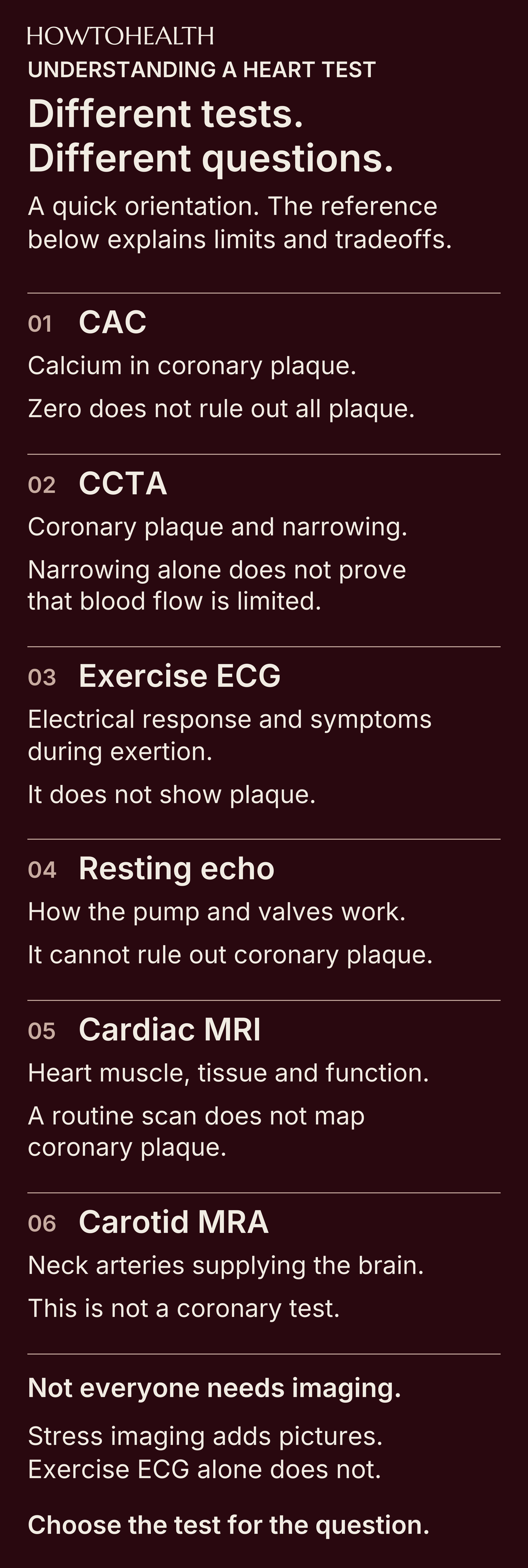
A resting echocardiogram uses ultrasound to show how the pump and valves work. An exercise test records how the heart responds to activity. Neither directly shows coronary plaque. A calcium scan looks for one feature of plaque; a zero score can miss buildup without detectable calcium, especially in younger adults. Reassuring results still have value, within what the test can tell us. Testing guidance, calcium and age
Investigating symptoms and choosing preventive treatment are different jobs. Not everyone needs imaging. The reference separates what six tests show, what they can miss, and coverage questions.
Leave knowing which next step is yours
If your result changed unexpectedly, compare it with the previous report: which value changed, by how much, and over what period? That helps you and your clinician review possible causes and decide whether to repeat it.
If inherited risk is the concern, work on the parts of your overall risk that can change, including LDL and blood pressure. Feeling well does not make preventive care unnecessary, and needing medication does not mean you failed.
If you are starting from scratch, routine primary care can establish your blood pressure and cholesterol picture. Choose one change you can repeat, such as adding beans to dinner or a regular walk.
Symptoms need their own answer. Recurring chest pressure, breathlessness with usual activity, or a decline in what you can comfortably do deserves assessment even after reassuring tests. Women can have microvascular dysfunction, small coronary vessels not working properly, or vasospasm, temporary artery tightening that can happen at rest, without major blockages. Symptoms alone cannot diagnose these conditions. Chest-pain guidance
New chest pressure or sudden unexplained breathlessness can be an emergency. Call 911 rather than waiting for an outpatient scan.
Before another heart test, ask: What will this tell me? What can’t it see? What would we do differently with the result?
Which would be more useful to you next: a closer look at statins, or menopause and your heart? Let me know in the comments.
Congratulations, we’re healthing.
Keep this reference for when you need it
Understanding a heart test
Contrast is a substance given during some scans to make the images clearer.
Coronary artery calcium score (CAC): how much calcified coronary plaque is visible?
A computed tomography (CT) scan, which uses X-rays to make pictures. It can help selected people when the decision about preventive treatment is uncertain. Zero is often reassuring about near-term risk, but means no detectable calcium, not necessarily no plaque. Noncalcified plaque is buildup without detectable calcium. It can grow or rupture, although not all is unstable. Earlier plaque may not register, especially in younger adults. Low-dose radiation; no injected contrast. CAC, age and zero
Coronary CT angiography (CCTA): what plaque and narrowing are present?
Can be an initial test for selected people with symptoms. Seeing a narrowing does not, by itself, tell us whether it is limiting blood flow. Uses radiation and iodine contrast. Kidney function and any previous reaction to contrast matter when choosing this test. CCTA
Exercise electrocardiogram (ECG): what changes with exertion?
Records electrical activity, symptoms, blood pressure, and how much exercise you can do. Changes can suggest that the heart is not getting enough blood; it does not show plaque. The starting ECG must be readable, and you need to be able to exercise enough for the test. No radiation or contrast. Stress testing
Resting echocardiogram: how are the pump and valves working?
Ultrasound that cannot rule out coronary plaque. No radiation; contrast sometimes improves images. Echo
Cardiac magnetic resonance imaging (MRI): how does the muscle look and function?
Can identify scarring or inflammation in the heart muscle. A routine scan does not map coronary plaque. It uses a magnetic field, without X-ray radiation; some exams use a contrast substance called gadolinium. Cardiac MRI
Carotid magnetic resonance angiography (MRA): are the neck arteries supplying the brain narrowed?
Does not examine coronary plaque or replace cardiac MRI. Routine screening without symptoms is not recommended. No X-ray radiation; it can be done with or without contrast. MRA, screening
Stress imaging adds pictures during exercise or after medicine that changes blood flow or makes the heart work harder. Ultrasound shows heart movement; nuclear testing or stress MRI assesses blood supply. Nuclear testing uses radiation. Radiation-free does not automatically mean best. Testing guidance, stress-test medicines
Reports may call plaque noncalcified, calcified, or mixed, rather than “soft” or “hard.” Calcium alone cannot establish danger or safety. How much plaque there is, where it is, and what it contains matter. Studies link statin use with less fatty material in plaque and denser calcium, so a rising calcium score alone cannot tell you whether treatment is working. Plaque study
Follow-up tracks cholesterol, blood pressure, blood-sugar measures when relevant, side effects, and symptoms. Lipids are commonly rechecked 4–12 weeks after starting or increasing treatment, then every 6–12 months. These checks show whether treatment is changing risk factors, not whether plaque is shrinking. Repeat calcium scans are not used to monitor treatment; another scan needs a specific question to answer. Monitoring, follow-up
Coverage varies. Insurers may require advance approval, records, or an appeal. There is no universal requirement to “fail” a stress test before CCTA, and approval does not guarantee payment. Check whether the facility is in your insurance network and what you would owe under your plan. For cash-pay imaging, request a written estimate including the scan, the person reading it, and contrast charges. Coverage example, estimates
If your report includes non-HDL cholesterol
Non-HDL cholesterol is total cholesterol minus HDL-C. It measures cholesterol in the carriers that can contribute to plaque. Transport, ApoB guidance
Inherited cholesterol and screening
Familial hypercholesterolemia (FH) is an inherited difficulty removing LDL, often causing very high levels from childhood. Adult LDL-C of 190 mg/dL or higher before treatment is a clue, not a diagnosis. Assessment includes repeating the blood test, reviewing family history, checking other causes such as an underactive thyroid, and sometimes genetic testing. A negative genetic test does not always exclude FH.
The 2026 U.S. heart-society guideline recommends routine cholesterol screening at 9–11, or as early as 2 when family history suggests FH. Adult screening starts at 19, generally every five years when risk is low. A parent’s unusually early heart attack or high Lp(a) also deserves attention beyond the basic calculation. Screening and FH
Menopause and hormone treatment
Menopause hormone therapy is medicine that replaces estrogen, sometimes alongside progesterone or a related hormone. Some studies of treatment started early suggest heart benefits; others found no improvement in artery measurements. Better cholesterol or artery-wall measurements do not themselves prove fewer heart attacks. Hormone therapy is not currently recommended mainly for cardiovascular prevention. For healthy women treating symptoms, the balance of benefits and risks is generally more favorable before 60 or within ten years of menopause. The hormone, dose, pills versus patches, and your health matter; some forms taken by mouth raise clot and stroke risk. Evidence and guidance
Premature ovarian insufficiency means the ovaries, which release eggs and make hormones, lose normal function before 40. It and early menopause need a different discussion. When safe, hormone therapy is generally recommended at least until the usual menopause age, around 50–52, to replace hormones lost early. That is a reassessment point, not an automatic stop date. Treatment after menopause can also help with symptoms or some bone-health needs, with regular review. Endocrine guideline
A closer look at statin evidence
Many original trials had funding from drug companies. The analysis combining results from multiple trials had public and charitable support. Funding deserves scrutiny alongside how a study was done and what it found. Funding and data access
For fatigue, a small trial found worse energy and tiredness with activity. A larger analysis combining trials found no increase in reported fatigue, using different ways to measure it. These studies alone cannot tell you whether your own tiredness comes from the statin. A symptom that starts after treatment is still worth evaluating, and treatment can be adjusted when needed. Smaller fatigue trial, larger analysis
Lindsay Savage, PA-C, Physician Associate
General education, not individualized diagnosis or treatment. Evidence reviewed through November 11, 2026.
Selected studies and guidance
Would love to hear your thoughts on alternative medicine to lower cholesterol, and more on menopause and HRT