



Reading in your inbox? Open the full article for every graphic and source.
Maybe vitamin D came up because you’re exhausted. Maybe it’s already in your prenatal or your multivitamin. Maybe you got a result back and your clinician said it was fine, the lab printed a flag next to it, and someone online said you should be twice as high, with K2.
Same tube of blood, three verdicts. You deserve an explanation before a shopping list.
Clinical observation: in my Michigan practice, many of the unsupplemented adult women I tested came back in the low twenties, and among the 16- to 18-year-olds I tested in winter, 14 to 19 ng/mL was common. Those are observations from one practice, not population estimates, but they’re why I have a point of view on this. I also have a stack of research that has gotten better, and more surprising, since I was in clinic. You’re getting both.
What vitamin D does, and what the test measures
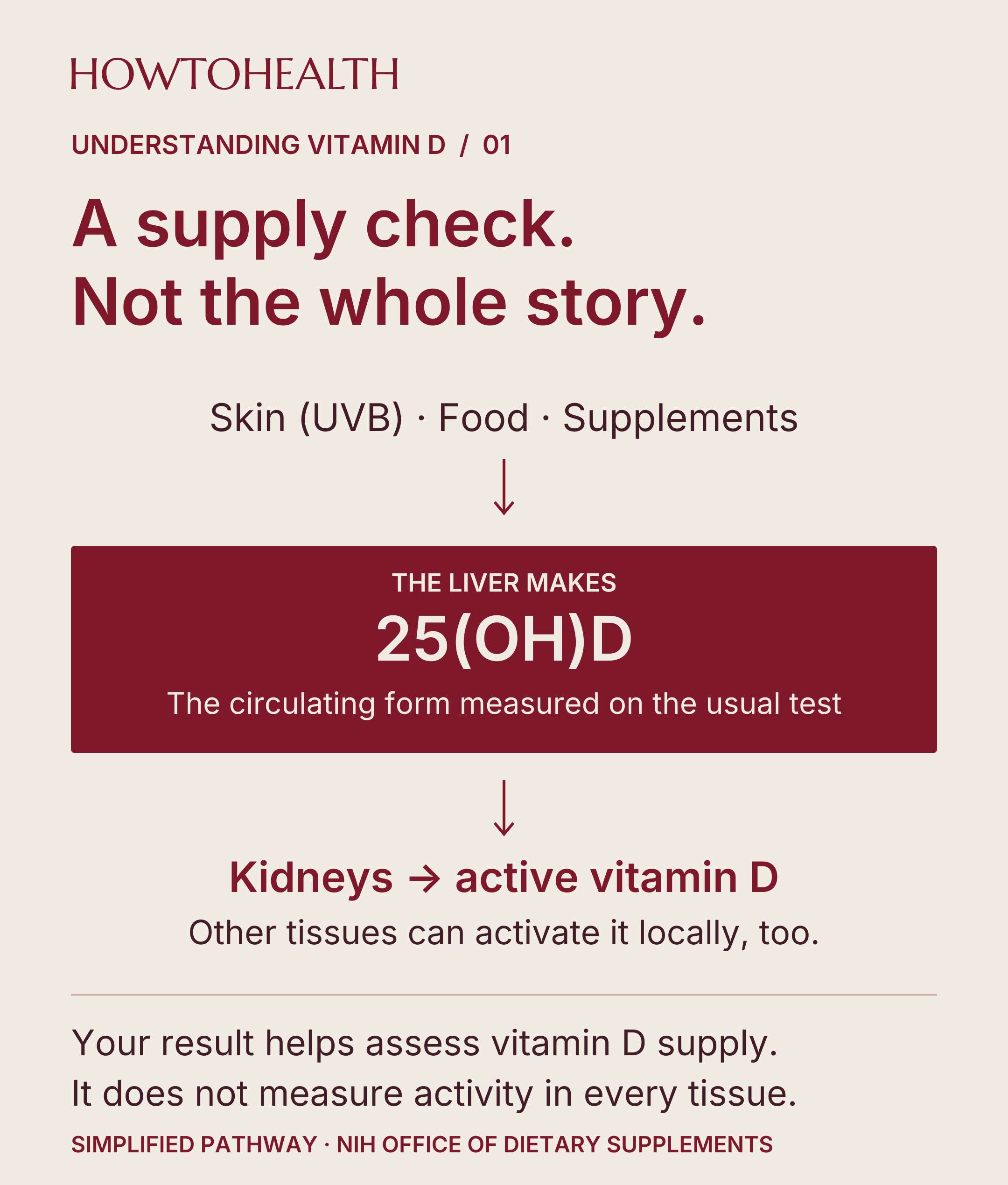
Vitamin D arrives three ways: your skin makes it from summer sun, you eat a little of it (fatty fish, fortified milk), or you swallow it. Whichever door it comes through, your liver converts it into a storage form, 25-hydroxyvitamin D. That storage form is what the standard blood test measures. Think of it as the inventory in a warehouse.
Well-established: your kidneys turn some of that inventory into the active hormone, calcitriol, in the amount your calcium system asks for. The hormone’s main job is helping your intestine absorb calcium and keeping the mineral supply to bone steady; it also takes part in muscle and immune function. Other tissues, including immune cells, skin, and the placenta, can make small amounts of the hormone locally for their own use. NIH vitamin D fact sheet, Vitamin D physiology review
So the test tells you how stocked the warehouse is. It does not measure how much hormone your tissues are making or what it’s doing there, and it isn’t supposed to. Much of the argument about vitamin D is an argument about how full the warehouse should be.
Deficiency, symptoms, and prevention are three different questions
Most of the conflicting advice you’ve heard comes from people answering different questions as if they were one.
Do I have enough for normal function? This is deficiency. Well-established: below 20 ng/mL, and especially below 12, the risk of problems from inadequate supply rises: bone softening (osteomalacia) and a parathyroid gland working overtime to defend your calcium. A result below 20 doesn’t diagnose those by itself; it marks the zone where correcting supply matters, and that stays true even when a trial finds that extra vitamin D did nothing for people who already had enough. NIH vitamin D fact sheet
Could a low level be part of how I feel? Possibly, for some symptoms, in people who are deficient. The trial most of us would want, vitamin D in tired young adults who were actually low, is small: 120 adults, mean age 29, about half women, a single large dose. Four weeks later, fatigue scores had fallen more than with placebo, and 72 percent reported feeling less fatigued versus 50 percent on placebo. That supports taking a real deficiency seriously when a woman is exhausted. It doesn’t make vitamin D an energy supplement. Fatigue trial in deficient adults If your number comes up on treatment and your exhaustion doesn’t, that’s useful information: the deficiency may have been worth fixing, and the fatigue still needs attention. Sleep, iron, thyroid, mood, medications, and the load you’re carrying all belong in that conversation. An improved lab result and an improved life are related goals, not interchangeable ones.
If I already have enough, would more protect my future health? This is where the biggest promises get less certain. VITAL enrolled 25,871 U.S. adults, about half of them women and including 5,106 Black participants; most already had adequate vitamin D. It found no reduction in new invasive cancers or major cardiovascular events, and its fracture study found no reduction over five years. A related study found no benefit for preventing depression. These trials were not designed to test correction of an established deficiency, an important limitation discussed in a 2024 international consensus. That cuts both ways: the trials don’t prove extra vitamin D is useless, and they don’t show a benefit from raising an adequate level either. Evidence in young, deficient women, who are rarely enrolled, remains thin. VITAL fracture results, VITAL main results, VITAL depression results, 2024 consensus on assessment and supplementation
Why recommendations and targets differ
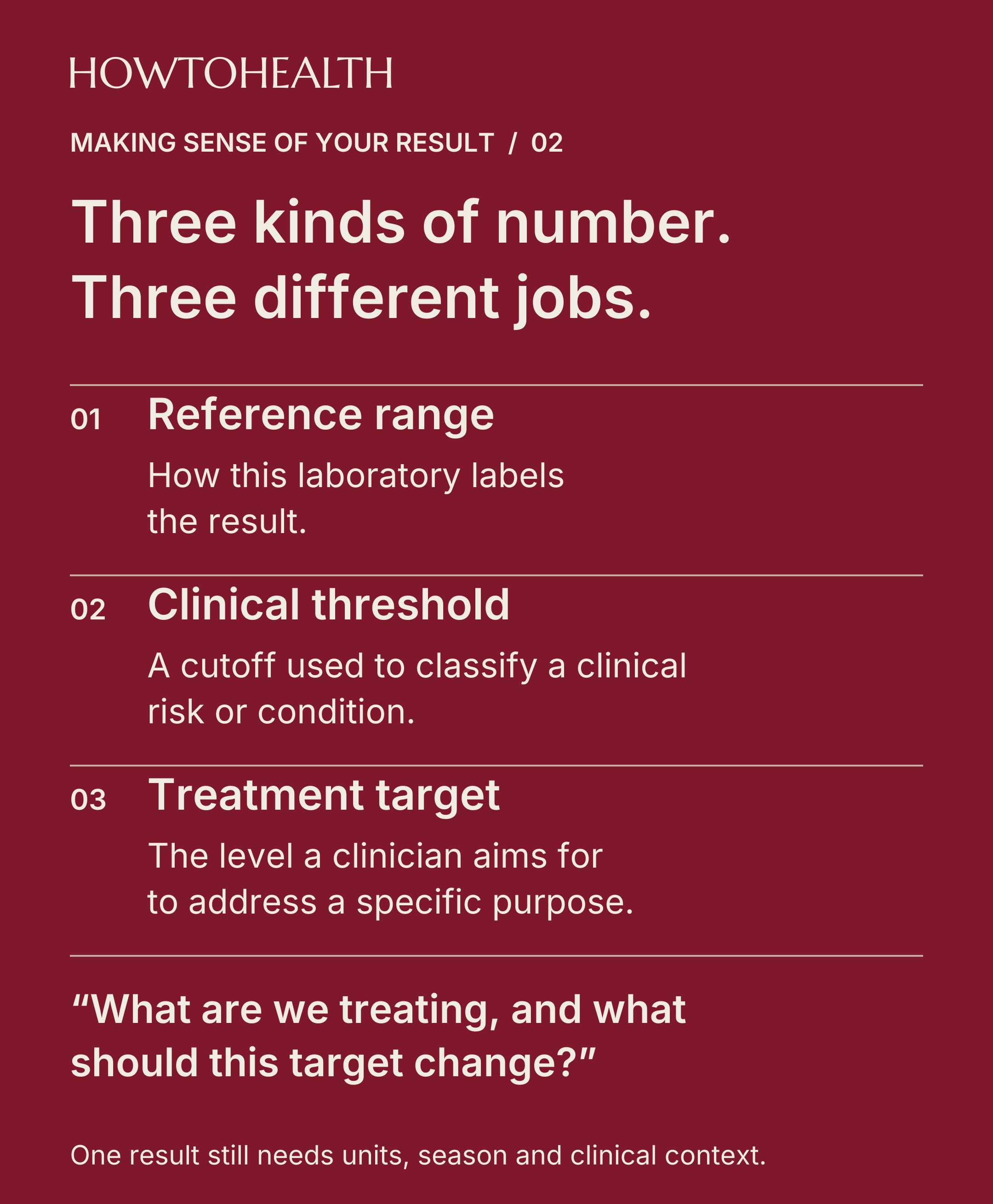
Three different kinds of number get printed as if they were the same thing.
A reference range is what a laboratory considers within normal for the test it runs. A clinical threshold is a cutoff used to identify possible inadequate supply or guide care. A treatment target is where a clinician is trying to get a particular patient. They don’t have to agree.
Units first: most U.S. labs report ng/mL, some report nmol/L, and 20 ng/mL equals 50 nmol/L.
The National Academies, summarized by NIH, set the thresholds most U.S. guidance uses: below 12 ng/mL, risk of deficiency; 12 to 19, potentially inadequate for some people; 20 and above, adequate for bone health in nearly everyone; above 50, linked to potential adverse effects in observational data, particularly above 60. Those were set to answer a population nutrition question. NIH vitamin D fact sheet
In 2011 the Endocrine Society, writing for clinicians treating deficiency, described 30 to 100 ng/mL as sufficient; Quest’s 30-to-100 reference range follows that historical guideline.
Mayo Clinic Laboratories uses a different source and prints 20 to 50 as optimum, with a flagged category from 51 to 80 for increased risk of high urine calcium, which its note ties to levels sustained above 50 along with prolonged calcium supplementation. Neither lab is wrong; they’re answering different questions, and a reference range is where a lab draws its lines, not a promise that every level inside it is good for you.
In 2024 the Endocrine Society, this time writing about prevention in generally healthy people rather than treatment of established deficiency, stopped endorsing 30 as the definition of sufficiency, because trials never identified a level that reliably predicts benefit from supplementing. A 2024 international consensus says it plainly: optimal levels remain debated, and societies differ because they weigh different clinical and public-health approaches. Endocrine Society 2011 guideline, Quest test 92888, Mayo Clinic Laboratories 25HDN, Endocrine Society 2024 guideline, 2024 consensus
Why integrative and functional clinicians often aim higher. If you’ve seen one of us, you’ve probably heard a target of 40 to 60, 50 to 80, or 50 to 90. The case rests on association studies (people with higher levels have less disease, though they also spend more time outside, weigh less, and are healthier to begin with), on physiology (tissues outside the kidney make their own hormone from the circulating supply), and on the point that the big trials dosed people who already had enough. Each is real. What research has not established is a universal higher target for energy or immune outcomes, or safety for holding a level for years; it also hasn’t ruled one out for the deficient younger women who are rarely studied. Dissenting view, 2024, Extrarenal vitamin D activation
Clinical observation: my own target was above 50 and preferably below 90 ng/mL, generally for energy and immune function, and I rechecked about three months after starting replacement because the dose that gets a woman there varies. My reasoning was to correct low levels promptly and address a possible contributor to her symptoms. In practice I rarely saw levels above 60, let alone 90. That is a practice target and a practice observation, not an outcome-proven range and not proof that higher levels are safe for everyone. Many conventional references treat 20 to 30 as sufficient, so ask what range your clinician is using and what she expects it to do for you.
It helps to separate three things: raising a low blood level, relieving symptoms that were due to deficiency, and holding a level high for years in the hope of preventing disease. Temporary higher-dose replacement for a deficient adult has a clinical rationale and adult research behind it. That doesn’t settle the long-term question, and lack of proven benefit is not proof of harm any more than lack of observed harm is proof of safety.
One Calgary trial studied long-term higher dosing in 311 generally healthy adults aged 55 to 70, who were not recruited for deficiency treatment. They took 400, 4,000, or 10,000 IU daily for three years. The higher-dose groups lost more bone density at the wrist, more so among women in an exploratory analysis, and more of them had high urine calcium. Current evidence suggests that long-term high dosing in replete older adults doesn’t help bone and may cost some. The trial was designed around bone-density outcomes and couldn’t establish an effect on fracture risk; it didn’t test treating deficiency and didn’t randomize blood targets; calcium supplementation and the potency of some preparations also mattered, as the authors have discussed. It’s a caution about long-term “more” in people who have enough, not a verdict on a short replacement course for someone who is low. Calgary trial, Calgary trial, results by sex, Authors’ clarification
Two things move the number without changing your routine: season and estrogen. At Michigan’s latitude, skin makes little vitamin D from about November through February, and levels often run lower in late winter than in late summer; in one cohort of older adults the average swing was about 10 ng/mL, with real variation between people. A February result is real, and it’s usually one of the lower points in your year rather than your average. Estrogen-containing contraception raises the protein that carries vitamin D and can change the total, in a way that varies by formulation. Season and latitude, Seasonal pattern in 3.4 million samples, Seasonal variation in the Cardiovascular Health Study, Contraceptive formulations and vitamin D
Food, supplements, and safety, without making it a second job
Food and sun. Few foods carry much: fatty fish, cod liver oil, UV-exposed mushrooms, fortified milk, egg yolks. The recommended daily intake is 600 IU through age 70 and 800 after, from all sources, assuming minimal sun. In a Michigan winter, food alone rarely gets there, which is why a supplement is a reasonable winter tool. Dermatologists don’t recommend sun or tanning as a vitamin D strategy, and I’m not going to argue with them here. NIH vitamin D fact sheet, American Academy of Dermatology
Three categories of dose that get confused. The tolerable upper intake for adults, from all products combined, is 4,000 IU a day. That is a limit for routine, unsupervised use, and it counts every product you take. A temporary replacement course for a diagnosed deficiency is different: a clinician may use higher doses for a defined period with a recheck, and that has adult research behind it. Maintenance after correction is different again, usually a lower ongoing dose. Know which one you’re on, when it ends, and what comes next. NIH vitamin D fact sheet, 2024 consensus
D3, meals, and a routine. Both D2 and D3 raise blood levels; D3 generally raises them more effectively. If your level barely changes on a prescription, ask about the form, the schedule, and whether absorption or missed doses could be involved. Taking D3 with a meal containing some fat can help absorption. For adults 50 and older who need supplementation or treatment, the 2024 Endocrine Society guideline favors daily lower doses over larger intermittent doses. Follow your prescribed schedule; large intermittent doses in older adults have sometimes increased falls. Clinical observation: I often preferred a liquid D3/K2, including drops with 1,000 IU each, because it’s easy to adjust; that’s a practice preference, not evidence that liquid works better. Whatever the form, check whether the label gives the amount per drop, per dropper, or per serving. That distinction can help prevent dosing mistakes. D2 versus D3, meta-analysis, Dietary fat and absorption, Endocrine Society evidence review, 2024
Rechecking. On a steady daily dose the blood level settles over about three months, which is why that was my checkpoint. Whether and when to recheck after that depends on why you were treated and how you responded. For a healthy adult with no symptoms or risk factors, the U.S. Preventive Services Task Force found the evidence insufficient to recommend for or against screening, and the 2024 Endocrine Society guideline suggests against routine testing. Time to steady state, USPSTF, Endocrine Society 2024 guideline
Does D3 need K2? Vitamin K activates proteins involved in bone and in keeping calcium out of blood-vessel walls, and K2 supplements reliably change those protein markers. The mechanism is real. In a three-year trial, 142 postmenopausal women with osteopenia took calcium and D3 with or without K2. Adding K2 changed a vitamin K-related protein marker but did not improve bone density or microarchitecture compared with placebo after three years. That study does not establish a benefit for younger women or during pregnancy. K2 has not been established as protection against taking too much vitamin D. If you take warfarin or a related blood thinner, do not start or stop a K2 product without your anticoagulation clinician. K2 added to calcium and D3, three-year trial, NIH vitamin K fact sheet
Safety. True vitamin D toxicity, with dangerously high blood calcium, is rare and has come from manufacturing errors or large dosing mistakes. Before that point, calcium can run high in the urine or blood without obvious symptoms, which is one reason higher-dose treatment belongs under a clinician. Reasons to involve a clinician before supplementing at more than routine doses: pregnancy, a history of kidney stones or high blood calcium, kidney or liver disease, sarcoidosis or lymphoma, an overactive parathyroid gland, or a thiazide diuretic plus calcium. Reasons to be seen: new bone pain, muscle weakness, a fracture from a minor fall, or, on supplements, unusual thirst, frequent urination, nausea, constipation, or confusion. Vitamin D toxicity case review, NIH vitamin D fact sheet
What to do next
Ask which question you’re answering: correcting a deficiency, investigating a symptom, or trying to prevent something.
If you’ve never been tested and feel well, you don’t need a lab result to start. The general recommended intake is 600 IU a day through age 70 and 800 after, from food and supplements combined; the adult upper limit of 4,000 IU a day is a ceiling for routine use, not a daily goal. Treating a diagnosed deficiency is a separate, individualized decision. A test is for a reason (a symptom, a risk factor, a treatment to check), not a ritual. NIH vitamin D fact sheet
Keep the result, the units, the month, the lab, and whether you were on estrogen together. That context helps your clinician interpret the result.
Add up the vitamin D across every product you take.
If you’re treating a low level, know the dose, the duration, the recheck point, and what would change the plan.
If a target is recommended to you, ask what it’s expected to do for you and what that rests on. A good answer names the outcome and the evidence, and your clinician should be able to explain how the guidance applies to you.
Has anyone ever explained to you what the month you drew your blood in does to the number?
Congratulations, we’re healthing.
Sources
Vitamin D Fact Sheet for Health Professionals, NIH Office of Dietary Supplements
Vitamin D and fatigue in deficient adults, randomized trial, Medicine, 2016
Supplemental vitamin D and incident fractures, VITAL, New England Journal of Medicine, 2022
Consensus statement on vitamin D status assessment and supplementation, Endocrine Reviews, 2024
Evaluation, treatment, and prevention of vitamin D deficiency, Endocrine Society guideline, 2011
Quest Diagnostics test directory, 25-hydroxyvitamin D, test 92888
Mayo Clinic Laboratories, 25-hydroxyvitamin D2 and D3, interpretation
Vitamin D for the prevention of disease, Endocrine Society guideline, 2024
Revisiting the vitamin D guideline, dissenting view, Endocrine Practice, 2024
High-dose vitamin D and bone density and strength, Calgary trial, JAMA, 2019
Calgary trial, results by sex, Journal of Bone and Mineral Research, 2020
Calgary trial, authors’ clarification, Journal of Bone and Mineral Research, 2021
Vitamin D seasonality in the United States, 3.4 million samples, PLoS One, 2013
Vitamin D position statement, American Academy of Dermatology
Dietary fat increases vitamin D3 absorption, Journal of the Academy of Nutrition and Dietetics, 2015
Screening for vitamin D deficiency in adults, U.S. Preventive Services Task Force, 2021
Vitamin K Fact Sheet for Health Professionals, NIH Office of Dietary Supplements
About the evidence: reviewed last on November 5, 2026, drawing on the HowToHealth research dossier, clinical guidance, and selected primary studies; a focused editorial review, not a systematic one. Trial findings in older adults are not assumed to apply at every age. The clinical observations are my account of my own practice and are not efficacy evidence. I have no relationship with any laboratory, and no product or dispensary is linked here.
This is general health education, not individualized medical advice. It cannot diagnose a deficiency, interpret your result, or set your dose. Keep any prescribed treatment in place while you discuss changes with your clinician.